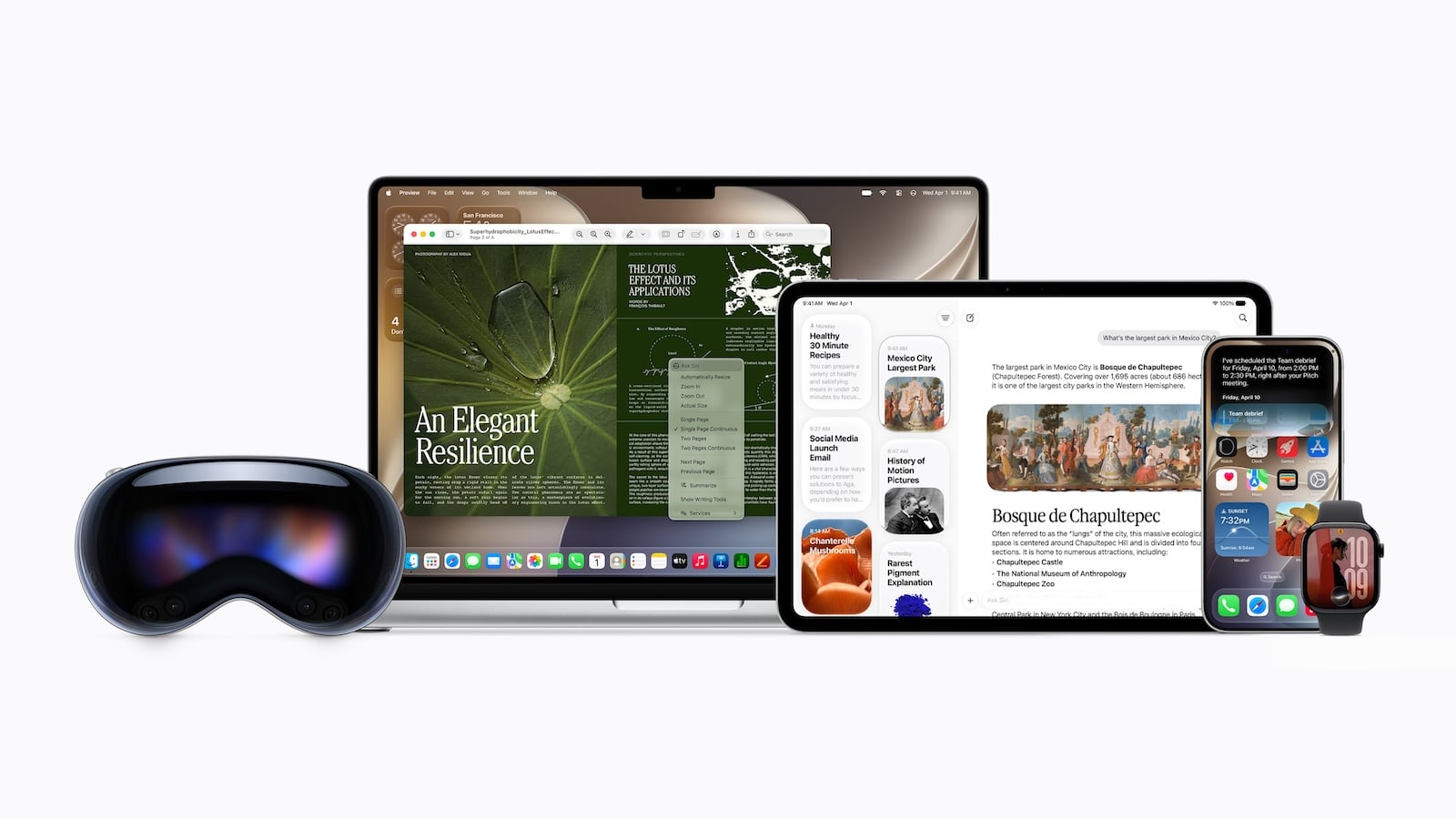
Apple Intelligence is no longer a future promise, but an integral part of iOS, iPadOS, macOS, and visionOS – in German and in the EU. Users with compatible devices often already have the AI features active without realizing it. Where they are missing, it's usually due to a minor setting.
When Apple Intelligence launched, the system was initially limited to US English and a small number of devices – for months it was completely unusable in the EU. All of that has changed: since iOS 18.4, the AI has also been available in German and in Europe; with iOS 26, iPadOS 26, and macOS Tahoe 26, it's firmly integrated into everyday use; and iOS 27 brings the next generation of AI features. Setup itself is straightforward and in practice almost exclusively fails due to compatibility issues or an incorrectly selected language.
What Apple Intelligence is
Apple Intelligence is Apple's personal AI system that operates as directly on the device as possible. Requests are processed locally without collecting or permanently storing personal data in the cloud. If the device's processing power is insufficient, Private Cloud Compute takes over, extending data protection guarantees from the device to the cloud: even there, requests are not stored and are inaccessible to Apple or third parties. Apple developed the underlying models of the new generation in collaboration with Google, based on Gemini technology, but they operate within precisely this data protection framework. The goal remains twofold: powerful AI and privacy protection.
These devices support Apple Intelligence
Apple Intelligence is heavily reliant on hardware because the AI calculations run locally. The chip is crucial: iPhones require at least an A17 Pro, while iPads and Macs need an M1 or newer. This clearly defines which models support Apple Intelligence.
- iPhone 15 Pro and iPhone 15 Pro Max, as well as all iPhone 16 models and newer, including iPhone 16e, the iPhone 17 series and iPhone Air
- iPad mini with A17 Pro and all iPad models with M1 or newer (iPad Pro and iPad Air from the M1 generation onwards)
- all Macs with Apple Silicon, i.e., M1 or newer
- Apple Vision Pro running visionOS 26
The Apple Watch itself doesn't run AI models, but it benefits from certain features like live translation when paired with a compatible iPhone. Sufficient free storage is also crucial: you should plan for around 7 GB for the initial download of the AI models, and this requirement will increase as more features are added.
Enable Apple Intelligence
How Apple Intelligence becomes active depends on the system version.
In iOS 27, iPadOS 27, macOS 27, and visionOS 27, AI is deeply integrated into the system and enabled by default on compatible devices. There is no longer a separate main switch – once the device is set to a supported language, it automatically loads the models, and the features are available. Users can then control individual functions, not Apple Intelligence as a whole.
In iOS 26 and its sister systems, however, there is still a central switch. If Apple Intelligence is not already active after the update, you can turn it on manually:
- On iPhone and iPad: Open Settings, tap "Apple Intelligence & Siri" and activate the switch next to "Apple Intelligence".
- On Mac: Open System Preferences, click on "Apple Intelligence & Siri" and turn on "Apple Intelligence".
- On the Apple Vision Pro: Open the settings, go to "Apple Intelligence & Siri" and activate the function.
In both cases, the device then downloads the AI models. This takes varying amounts of time depending on the connection; it's fastest if the device remains connected to Wi-Fi and a power source. Only then are all functions fully available.
Set the correct language
Apple Intelligence only works if the device language and Siri language are set to the same supported language – for German-speaking users, both must be set to German. The device language is found under Settings > General > Language & Region, and the Siri language is found in the Siri settings under "Language." If they don't match, the AI features will be unavailable or will only appear once the new Siri language has fully loaded.
Numerous languages are now supported, including German, English, French, Italian, Spanish, Dutch, Portuguese, Danish, Norwegian, Swedish, Turkish, Japanese, Korean, Vietnamese, as well as Simplified and Traditional Chinese. How well Apple Intelligence handles multiple languages simultaneously depends on the specific function.
Which functions are immediately available
When Apple Intelligence is active, its features are distributed throughout the entire system. Writing tools assist with text correction, rewording, and summarizing - directly within apps and on websites. Image Playground allows for creative use of your own images, while Genmoji enables personalized emojis. Visual Intelligence uses the camera to recognize objects, text, and locations in the environment.
In Mail and Messages, the system summarizes long conversations and suggests appropriate replies, while the "Reduce Interruptions" focus highlights only the most important messages. In the Photos app, the Clean Up tool removes distracting image content, and Search understands natural language. Siri also benefits from Apple Intelligence: with improved product knowledge about your devices, a more natural voice, and the ability to type requests instead of speaking. Users can also integrate ChatGPT into Siri and the writing tools – participation is optional and will be confirmed beforehand.
What's next for Apple Intelligence
Apple Intelligence continues to grow with each iOS generation. The biggest step is Siri AI, a completely redesigned version of Siri that works more closely with apps and personal context. However, in the EU, this new generation of Siri on iPhone and iPad is subject to the Digital Markets Act (DMA) – the reason the DMA is limiting Siri AI there lies in the strict interpretation of EU regulations. The other AI features are unaffected and are available in the EU and in German.
Make the most of Apple Intelligence in everyday life
To ensure the AI runs smoothly, it's worth keeping the system and Siri languages consistent, using Wi-Fi and a power source during initial setup, and keeping the operating system up to date – even minor updates often bring noticeable improvements in the quality and speed of AI functions. Individual functions can be selectively disabled at any time; whether and how Apple Intelligence can be completely deactivated varies depending on the system version. This allows you to control which functions are active in everyday use.
The best products for you: Our Amazon Storefront offers a wide selection of accessories, including for HomeKit. (Image: Apple)
- Shortcuts in iOS 27: How to easily create automations using descriptions
- Which USB-C Cable Does Your Mac Need?
- Apple Silicon: How Much RAM Do You Really Need?
- How many external displays does your Mac support?
- iOS 27: Finally Set Alarm and Notification Volumes Separately
- Create a Pass in iOS 27: Create Your Own Wallet Passes
- iOS 27, iPadOS 27 and macOS Golden Gate: These Apple devices are compatible
- How to install the iOS 27 Developer Beta: guide, risks and troubleshooting
- Setting Up Apple Family Sharing Securely: What Parents Need to Know
- iCloud Private Relay vs. VPN: What Actually Protects You?
- How to protect Apple devices from malware
- Configuration Profiles on the iPhone: When They Help, When They Become Dangerous
- HomePod Plays Music on Its Own: How to Stop Ghost Touches
- Selling Your iPhone Safely: How to Prepare Your Device the Right Way
- Using Apple Pay Safely: How the iPhone Protects Your Payments
- Data Leak Check on iPhone: How to Find Compromised Passwords
- Spotting a Hacked iPhone: Real Warning Signs, Common False Alarms and the Right Steps
- Advanced Data Protection for iCloud: How to Use Apple's Strongest Encryption Tier
- NameDrop on iPhone and Apple Watch: How to Use It Right
Frequently Asked Questions: Setting up Apple Intelligence
A compatible chip is required: at least an A17 Pro for the iPhone, and an M1 or newer for the iPad and Mac. Specifically, this includes the iPhone 15 Pro and 15 Pro Max, all iPhone 16 models and newer (including the iPhone 16e, iPhone 17 series, and iPhone Air), the iPad mini with an A17 Pro, all iPads with an M1 or newer, all Macs with Apple Silicon, and the Apple Vision Pro. The Apple Watch uses certain functions via a paired, compatible iPhone.
This depends on the system version. On iOS 27 and its sister systems, Apple Intelligence is enabled by default on compatible devices – as soon as the language matches, the device automatically downloads the models. On iOS 26, you can enable it manually if needed: Open Settings (System Preferences on a Mac), select "Apple Intelligence & Siri," and activate the switch next to "Apple Intelligence.".
With iOS 27, Apple fully integrated AI into the system and merged it with Siri. The previous central toggle under "Apple Intelligence & Siri" is therefore gone; the corresponding settings entry is now simply called "Siri." Apple Intelligence is enabled by default on supported devices – individual functions can be disabled instead.
Yes, German has been fully supported since iOS 18.4. In addition, English, French, Italian, Spanish, Dutch, Portuguese, Danish, Norwegian, Swedish, Turkish, Japanese, Korean, Vietnamese, as well as Simplified and Traditional Chinese are available, among others. Important: The device language and Siri language must be set to the same supported language; otherwise, the functions will not be available.
Approximately 7 GB should be allocated for the initial download of the AI models. The required amount increases as more functions are used, so having some buffer space is advisable.
This varies depending on the version. In iOS 26, Apple Intelligence can be completely disabled via the central switch, which removes the loaded models from the device. In iOS 27, there is no longer such a central switch – here, only individual functions can be deactivated, such as summaries in Mail and Messages or the ChatGPT integration.
Most Apple intelligence features are available in the EU and in German. One exception is the new generation of Siri (Siri AI): In the EU, it will not initially launch on iPhone and iPad, but it is available on Mac and Apple Vision Pro.