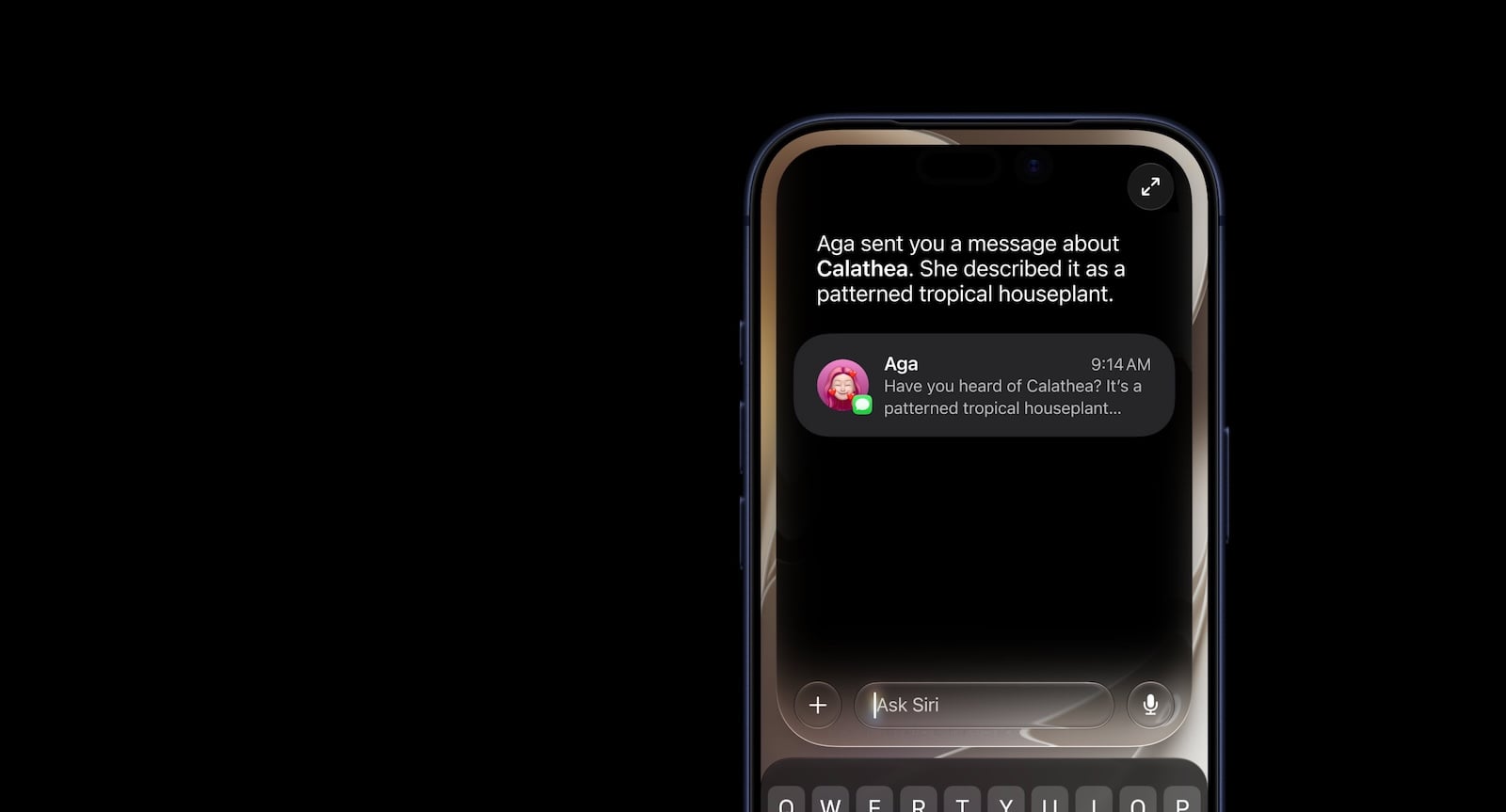
It's well known that the new Siri and other Apple intelligence features are based on Google's Gemini models. However, Apple emphasizes that this is not the same as running Gemini on the iPhone. Meanwhile, a much clearer picture is emerging of what lies behind this distinction.
With the new Siri unveiled at WWDC, Apple is departing from its previous strategy of relying exclusively on its own models. Instead, it's using Google technology – albeit in a form that Apple has carefully distinguished from a simple "Gemini on the iPhone." While some details remain unclear, the underlying architecture is now fairly easy to understand: it involves custom-designed models, a special server infrastructure, and the question of what all this means for privacy.
Siri AI is not Gemini Assistant
What causes confusion is that Google uses the term "Gemini" for quite different things. On the one hand, Gemini is the name of a whole range of AI models. On the other hand, Google's counterpart to Siri is called "Gemini Assistant"—although Google often omits the "Assistant" part and simply refers to it as Gemini.
One thing is clear: Even though both assistants are based on Gemini models, they are completely separate. Siri AI is therefore not a rebranded version of Gemini Assistant, but an independent system.
Built on Gemini – but rebuilt for Apple
Apple itself refers to this as the third generation of its Apple Foundation Models, a family of five base models custom-designed in collaboration with Google. Google had already officially confirmed that the new Siri is based on Gemini technology – including its role as the preferred cloud provider.
An analysis by Macworld writer Jason Snell clarifies what Apple has and hasn't said. According to Snell, four of the five models are customized versions of Gemini running on Apple Silicon, while the fifth and most powerful model is essentially Google's standard model on Google servers – presumably with different training data. Siri AI doesn't access Google's web search or its Knowledge Graph, but instead uses its own sources. Craig Federighi openly states that the four models running on Apple Silicon were trained with Apple's own data, refined using reinforcement learning, and further sharpened with outputs from the top-tier Gemini models. The most powerful model was likely trained with both Google's and Apple's data.
In simpler terms, this means: Apple started with Gemini's base models, optimized and rebuilt them for Apple Silicon and the required model sizes, and then retrained them with its own data, weightings, and protection rules.
What this means for data protection
Crucial to Apple's brand promise is where the processing takes place. Two of the four smaller models run directly on the device – meaning the data never leaves your iPhone, which offers the highest possible level of protection. Two others run on Apple Silicon chips in Apple's own Private Cloud Compute Infrastructure (PCC). This infrastructure is designed so that neither Apple nor Google can withhold or view data – and this can be independently verified by security researchers, instead of simply having to take Apple's word for it.
The most powerful model, in turn, runs on Google servers. However, these are servers reserved exclusively for Apple, and although NVIDIA GPUs are used here instead of Apple Silicon, Apple states that the same PCC principles apply: stateless processing, enforceable guarantees, no privileged runtime access, non-addressability of individual users, and verifiable transparency. How Apple implements these guarantees on third-party hardware - including NVIDIA Confidential Computing, Intel TDX processors, and Google's Titan chip - is revealed by examining the PCC infrastructure extended to Google Cloud.
A shred of trust remains
PCC on Google servers is technically not the same as PCC on Apple's own hardware. This is precisely where the line is drawn between what can be independently verified today: On the device itself and in Apple's own cloud, security researchers can trace the protection mechanisms, whereas the configuration on Google servers is comparatively new and less tested. This doesn't invalidate Apple's assurances, but it does call for sober caution – new architectures can contain vulnerabilities that simply haven't been discovered yet. The fact that Apple runs its most powerful AI model on third-party infrastructure also shifts the balance of power in relation to Google – and explains why the distinction between "runs on Gemini" and "is Gemini" is so important to the company. (Image: Apple)
- WWDC 2026: Apple's keynote breaks with an old tradition
- Why the DMA Stops Siri AI on iPhone and iPad
- Apfelpatient Weekly #9
- iPhone 18 Pro: All the rumors at a glance
- iPhone Ultra (iPhone Fold): All rumors and facts at a glance
- WWDC 2026: All expectations, rumors and hardware hopes at a glance
- Apple TV in June 2026: All the highlights at a glance
- Apfelpatient Weekly #8
- New Apple TV 4K: All the rumors about the update
- HomePod 3 & HomePod mini 2: All the rumors at a glance
- Apple Glasses: All the rumors at a glance
- Apfelpatient Weekly #7
- iPhone 2027: All the rumors about the anniversary model
- MacBook Ultra: All the rumors at a glance
- Apple Watch Ultra 4: All the rumors at a glance
- Apfelpatient Weekly #6
- Apple Watch Series 12: All the rumors at a glance
- Apfelpatient Weekly #5
- AirPods Ultra: All the rumors at a glance
- Apple TV in summer 2026: The strongest lineup yet
- Siri strategy: Why AI choice is Apple's most important step in years
- Mac Studio M5: All the Rumors at a glance
- iPhone 18: All the rumors at a glance