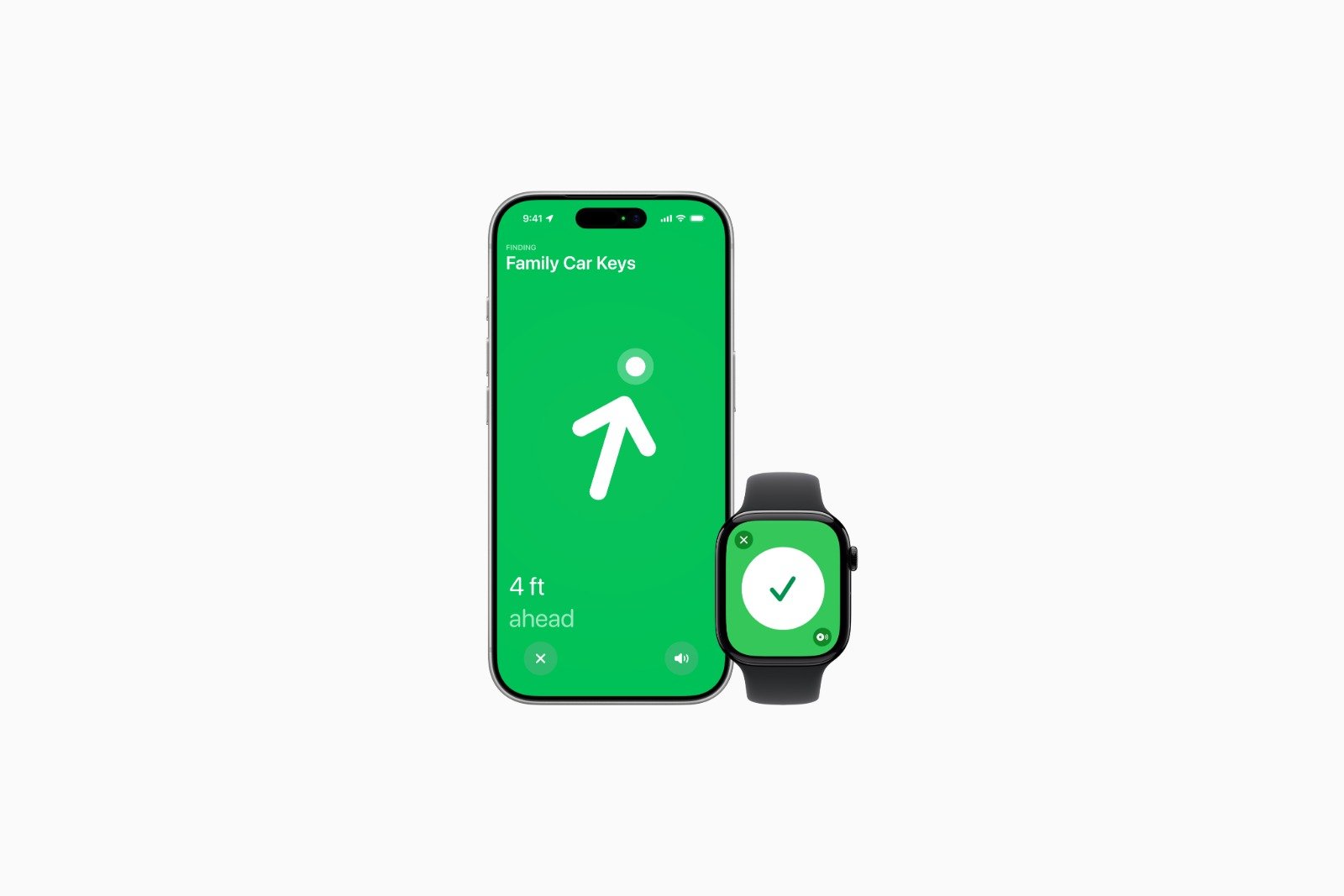
With AirTag 2, Apple has further developed its Bluetooth tracker. The focus is on improved precision searching, which, thanks to a new ultra-wideband chip, is supposed to offer a significantly greater range. However, this advantage is subject to certain conditions. Not every iPhone can use the enhanced function, even though AirTag 2 remains compatible with many devices.
At first glance, AirTag 2 appears to be a logical upgrade of the original AirTag. The design remains familiar, and the basic functions are known. The crucial difference lies beneath the surface. The precision finding function has been technically enhanced, which should make finding lost items easier. At the same time, Apple has defined clear limitations that are essential for using this improvement. Anyone working with AirTag 2 will inevitably encounter these details.
What makes AirTag 2's improved precision finding so special
AirTag 2 utilizes an advanced ultra-wideband chip. This enables up to 50 percent greater precision finding range compared to the first generation. In practice, this means an AirTag can be located from a greater distance, including precise directional information and distance readings.
This extended range is one of the most important new features of AirTag 2. However, it is not automatically available on every iPhone.
Prerequisite: Compatible iPhone models
According to a footnote on the official Apple website, AirTag 2's improved precision finding only works with certain iPhones. A newer Ultra Wideband chip is required, which Apple only started including in the iPhone 15 and later models. The following models fully support the enhanced precision finding:
- iPhone 17
- iPhone 17 Pro and iPhone 17 Pro Max
- iPhone Air
- iPhone 16
- iPhone 16 Plus
- iPhone 16 Pro and iPhone 16 Pro Max
- iPhone 15
- iPhone 15 Plus
- iPhone 15 Pro and iPhone 15 Pro Max
The iPhone 16e is explicitly excluded, even though it belongs to the same generation.
Technical background of the restriction
The reason for this limitation lies in a change to ultra-wideband technology. Apple introduced a new generation of these chips starting with the iPhone 15. Only this new generation can technically support the greater range of AirTag 2's precision finding.
Older iPhones also have an ultra-wideband chip, but it uses the same technology as the original AirTag. Therefore, the range remains unchanged.
Using AirTag 2 with older iPhones
AirTag 2 can also be used without problems with an older iPhone or the unsupported iPhone 16e. Features such as adding to the "Find My" network and the classic precision search are still available.
However, the precision finding range in this case is exactly the same as that of the first-generation AirTag. One of the key advantages of AirTag 2 – its up to 50 percent greater range – therefore cannot be utilized.
AirTag 2: Progress with clear hardware limitations
AirTag 2 brings a clear technological advancement with its enhanced precision finding, which can significantly improve the retrieval of lost items. However, this advantage is closely tied to specific iPhone models. Only devices from the iPhone 15 onwards, with the exception of the iPhone 16e, fully support the new range.
While AirTag 2 remains functional with older iPhones, it offers no noticeable added value compared to the original AirTag. Therefore, the actual benefit of AirTag 2 depends heavily on the existing hardware. To take full advantage of the new features, you need a compatible iPhone – otherwise, you'll only experience the familiar first-generation AirTag. The best products for you: Our Amazon storefront offers a wide selection of accessories, including those for HomeKit. (Image: Apple)
- iPhone alarm silent: Why the alarm suddenly stops working
- Safari at 120 Hz: How to activate smoother scrolling
- iOS 26 improves group chats with five new features
- Here's how to create Apple Music playlists with ChatGPT
- iOS 26: Change default apps on your iPhone
- Optimize your messaging app: Stop unwanted audio recordings
- iOS 26 turns photos into impressive 3D spatial scenes
- AirPods: Media no longer continues playing during sleep thanks to iOS 26
- Use Apple's Family Sharing to share content together
- iPhone tip: How alternative app distribution channels work
- iPhone tip: Access flight information directly in the system
- iOS 26.2 explained: How the new AirDrop codes work
- iOS 26.2 enhances the Reminders app with alarm functionality
- Here's how to properly create a backup for iPhone and iPad
- Setting up and using Apple Car Key: All functions explained
- New iOS 26.2 feature: Screen flashes for notifications
- Longer battery life with iOS 26 – Adaptive Power explained
- Live translation with AirPods: Here's how the feature works
- iOS 26: The new focus mode „Reduce interruptions“
- iOS 26.1: Reactivate the classic stop button on the alarm clock
- iOS 26.1 brings a new lock screen setting for the iPhone
- iOS 26.1: Liquid Glass effects can be toned down
- watchOS 26 brings hints about the Apple Watch dial
- macOS 26 Update: Hidden Tools and Improvements
Frequently Asked Questions about AirTag 2 and Precision Finding (FAQ)
The most important difference lies in the improved precision finding. AirTag 2 uses a new ultra-wideband chip that enables up to 50 percent greater range – but only with compatible iPhones.
Extended range only works with iPhones from the iPhone 15 onwards. This includes the iPhone 15, 15 Plus, 15 Pro, 15 Pro Max, and all newer models such as the iPhone 16, iPhone 17, and iPhone Air. The iPhone 16e is explicitly excluded.
The reason lies in the hardware. Apple introduced a new generation of ultra-wideband chips starting with the iPhone 15. Older chips do not technically support the greater range.
Yes, AirTag 2 is also compatible with older iPhones. Features like the "Find My" network and standard precision finding are still available, but without the range improvement.
Yes. With unsupported iPhones, the precision finding range is identical to that of the original AirTag. The key advantage of the AirTag 2 is therefore lost in this case.
Although the iPhone 16e belongs to the same generation, it apparently does not use the necessary ultra-wideband chip. Therefore, it cannot use the enhanced precision finding of AirTag 2.
Without a supported iPhone, AirTag 2 offers no noticeable added value compared to the first AirTag. It functions reliably as a tracker, but the technical innovation remains unused.
This is a hardware-dependent feature. Software updates alone are not sufficient, as the increased range is directly linked to the new ultra-wideband chip.