
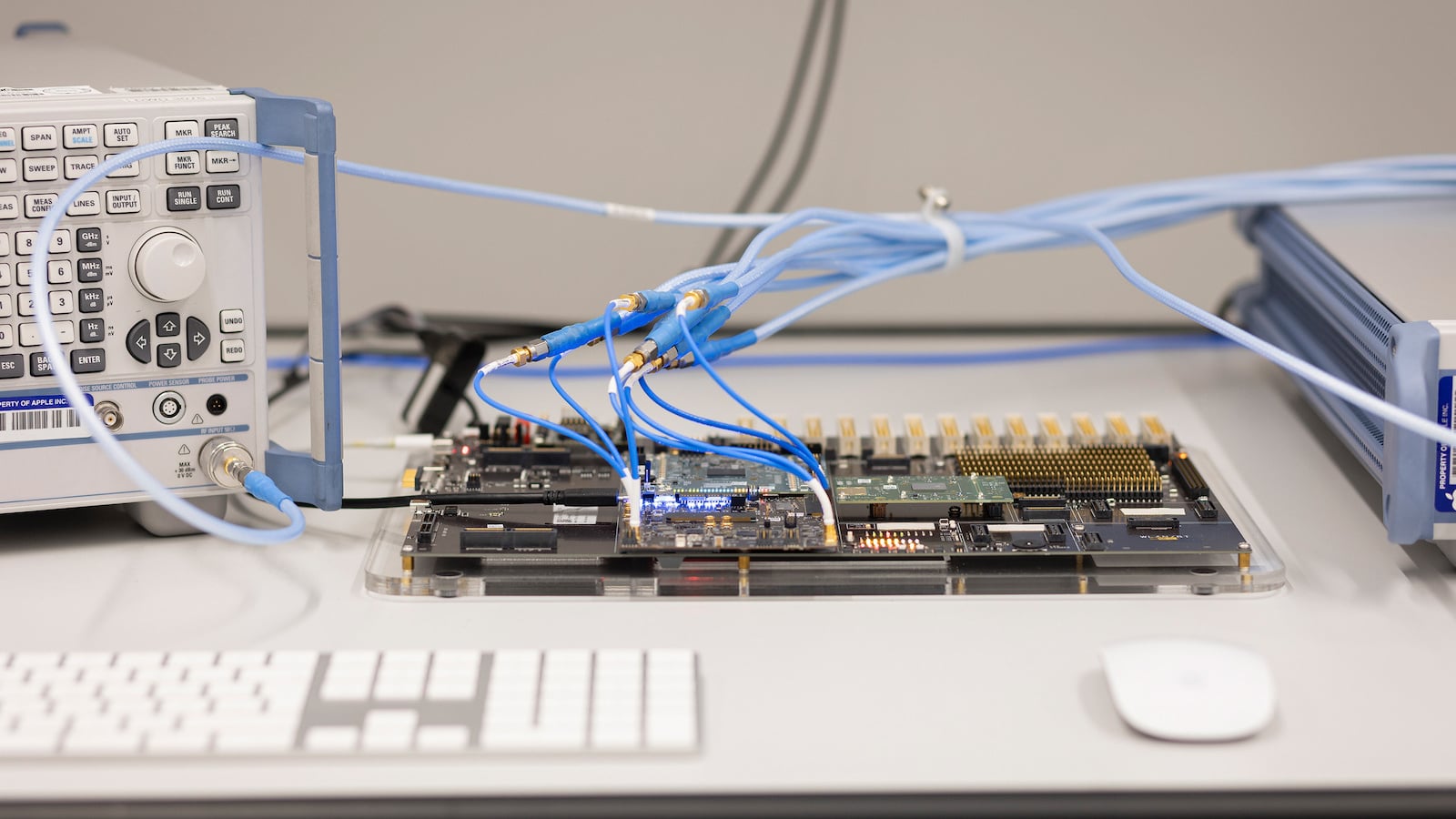
The memory shortage is forcing Apple to turn to a supplier that Washington has on a list of Chinese military contractors. For the first time, it is known in which products the chips are being tested – and a deadline is approaching in the Senate, expiring in eleven days.
For months, AI-driven demand for RAM has been driving up purchase prices, and in June Apple passed the cost increase on to its customers: Macs, iPads, and the Vision Pro became more expensive worldwide, while iPhones were initially exempt. At the same time, the company is searching for a fourth supplier in addition to Samsung, SK Hynix, and Micron. This search leads to ChangXin Memory Technologies, or CXMT for short – and thus directly into a conflict between purchasing logic and American security policy.
A report in the Wall Street Journal now describes how Apple is testing CXMT memory chips across several product lines, including iPhones and MacBooks. The newspaper cites people familiar with the matter; Apple and CXMT have not commented.
Key Facts at a Glance
- Apple is testing DRAM chips from Chinese manufacturer CXMT in several product lines, including iPhones and MacBooks.
- Concrete supply negotiations so far only concern devices that are to be sold in China.
- US export rules prohibit the disclosure of technical details to CXMT – thus ruling out custom-made chips.
- A bipartisan group of senators has given Apple until August 21st to exclude the device.
- An additional supplier is not lowering prices for the time being: CXMT is fully booked and its prices are on par with those of established manufacturers.
Tests across the entire product range, discussions only for the Chinese market
Apple involves several stages between testing and a purchase agreement. Technical qualification verifies whether a component meets the requirements for reliability, yield, and mass production readiness – it says nothing about whether and where a chip will later be used.
The two sets of reports diverge precisely at this dividing line. According to the report, the tests extend across several product categories, while the discussions held so far regarding actual deliveries concern only devices for the Chinese market. Apple hopes for approval from the White House before taking any further steps.
Other manufacturers are already further ahead: HP and Acer are using CXMT memory in notebooks sold outside the US. CXMT is now the world's fourth-largest DRAM manufacturer, while Samsung, SK Hynix, and Micron together hold around 90 percent of the market.
What US export rules prevent
American regulations prohibit US companies from sharing technology with CXMT – and this includes even discussions about technical details and product specifications. Kevin Wolf, an export control attorney at the law firm Akin Gump, described the boundary to the Wall Street Journal as follows: Apple may purchase off-the-shelf components and negotiate the price, but may not commission chips designed according to its own specifications.
This is a bigger problem than it initially sounds. Apple typically configures memory to work optimally with its own chip design. Standard components would mean redesigning parts of the hardware - or accepting performance that falls short of what would be possible with custom-tuned components.
One deadline expires on August 21st.
Apple is also facing political pressure. At the end of July, a bipartisan group of senators, including Jim Banks and Chuck Schumer, sent a letter to Tim Cook demanding that the use of memory chips from Chinese state-owned enterprises be banned in every Apple product, regardless of where it is sold. The Department of Defense lists CXMT and the NAND manufacturer YMTC on a list of Chinese military companies updated in June; both companies deny any military ties.
The reasoning given by the senators for rejecting the restriction to the Chinese market is noteworthy: once a component has passed the qualification for Apple production, its worldwide use is only a single procurement decision away. Apple is to answer the questions by August 21, 2026.
A precedent already exists. In 2022, Apple considered using NAND flash memory from YMTC for the iPhone but abandoned the project after resistance in Congress. YMTC remains on the Commerce Department's Entity List, while CXMT does not—meaning Apple would not formally need approval to purchase from CXMT.
The path to this point
| Date | Development |
|---|---|
| June 27, 2026 | Apple is lobbying in Washington for approval of storage products from China |
| July 8, 2026 | A Financial Times report describes for the first time the ongoing qualification of CXMT-DRAM |
| July 25, 2026 | The dispute with Micron over Chinese memory chips has reached the US government. |
| July 29, 2026 | Senators are demanding in writing that Apple cease operations, with a deadline of August 21. |
| August 9, 2026 | A report assigns the tests to specific product lines for the first time. |
Why a fourth supplier isn't driving down prices
An additional supplier is only helpful under two conditions: they must have surplus chips, and they must offer them at a lower price. CXMT currently meets neither of these conditions. According to the report, production for this year is fully booked, with priority given to domestic customers such as ByteDance, Tencent, and Xiaomi. Prices are on par with, and in some cases higher than, those of Micron, SK Hynix, and Samsung.
This confirms what has become apparent in recent weeks: Apple's attempt to exert price pressure through an additional supplier has failed, and more suppliers alone do not mean better terms. The negotiating power remains with the three established manufacturers.
What the storage dispute means for buyers in this country
An iPhone purchased in Germany, Austria, or Switzerland would not receive this storage capacity under the current circumstances – supply negotiations are focused on devices for China. Anyone interpreting this announcement as an immediate change to products sold in these countries is jumping to conclusions.
This development is relevant for another reason. It demonstrates how tight the storage supply has become when Apple considers a supplier with such political baggage and, moreover, offers neither spare capacity nor better prices. We therefore expect that device prices in German-speaking countries will not decrease in the coming months – the June increase was not a one-off correction, but the first visible stage of a cost wave that is still ongoing.
In practical terms, this means that if you have a Mac or an iPad on your shortlist, don't wait for prices to ease; instead, decide based on your needs and desired configuration. Our 2026 iPad buying guide, outlining the current differences in features, will help you determine which model is right for you.
The next milestone is August 21. How Apple responds to the Senate's questions will show whether the Chinese storage solution remains a serious option or quietly disappears from the list again, as it did in 2022. (Image: Apple)
- Made for iPhone: 43 more hearing aids, MacBook Neo included
- OpenAI halts work on the Astra AI model due to cyber risks
- iOS 26.6.1: Apple is apparently testing an interim update