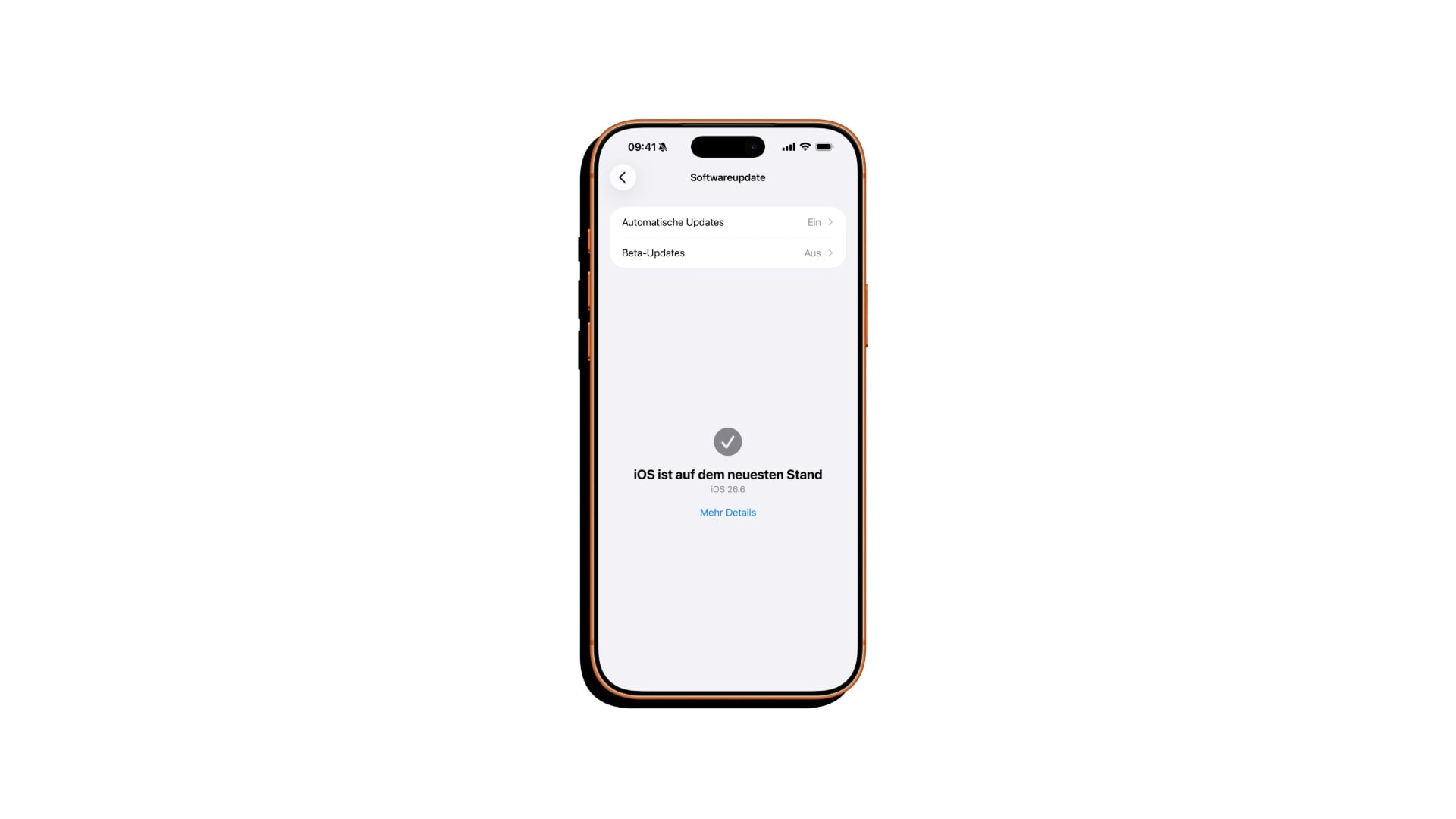
One day after the security update for Macs, devices running a previously unreleased iPhone version appeared in the access logs of two websites. Apple hasn't confirmed anything – but the reason is clear, and Apple announced in June that it would be releasing updates more quickly in the future.
Devices that visit websites leave behind their system version information. If identifiers appear that are not yet publicly available, they usually originate from Apple's internal testing environment. This is precisely what is now said to be the case for iOS 26.6.1. The connection is obvious, as just yesterday Apple closed a vulnerability in screen sharing with macOS Tahoe 26.6.1 – and such fixes rarely affect only one platform.
Key Facts at a Glance
- Devices running iOS 26.6.1 have independently appeared in the access logs of two websites, suggesting internal testing at Apple.
- Apple has neither confirmed the update nor a release date; its scope and content are unknown.
- On August 6, Apple updated three macOS generations to close a vulnerability in the "Screen Sharing" app.
- An interim update is likely to bring bug fixes and security patches, not new features.
- Those already using the iOS 27 beta will not be offered such an update.
What access logs reveal – and what they don't
The method is well-established and has worked multiple times in the past: Internal test devices access websites, and the system version logged there reveals what Apple is currently working on. This serves as useful proof that a version exists.
This time, the reliability is supported by the fact that two independent sites found the same version identifier. MacRumors first reported on the findings on Friday morning, shortly after 9to5Mac arrived at the same result in its own logs.
However, this finding doesn't serve as proof for anything further. The logs reveal nothing about the content of an update, nothing about the release date, and not even whether it will be released at all – Apple regularly discards internal builds. It's therefore an indication, not an announcement, and everything that follows is tentative.
The timing fits the pattern
More revealing than the discovery itself is the sequence of events over the past two weeks. Apple completed the 26.6 cycle at the end of July and has been releasing new updates sporadically since then.
| Date | What happened |
|---|---|
| July 20 | The iOS 26.6 release candidate is being sent to developers. |
| July 27 | iOS 26.6 is released and closes 78 security vulnerabilities. |
| August 6 | macOS Tahoe 26.6.1, Sequoia 15.7.9 and Sonoma 14.8.9 fix a vulnerability in screen sharing. |
| August 7 | Devices running iOS 26.6.1 appear in access logs. |
What's remarkable is the breadth of the Mac support: Apple has not only provided updates for the current generation, but also for its two predecessors. When a company patches three system generations simultaneously, the underlying gap in support is significant – and the likelihood increases that older iPhone models will also receive a fix.
That a Mac update and an iPhone update share the same version number is standard practice at Apple and not a coincidence. Both systems share large parts of their underlying architecture, which is why a security vulnerability often affects the same component on both platforms. The fact that iOS 26.6 alone closed 78 security vulnerabilities on iPhone and iPad in July demonstrates just how extensive this shared foundation is.
What should be included in version 26.6.1
There's no room for new features. Apple has completed the feature set of this generation with iOS 26.6, and iOS 27 is due in the fall. Experience has shown that an update with a third digit in the version number at this stage is primarily for bug fixes.
This will likely be a small package: the equivalent of the Mac fix, plus a few corrections to bugs reported since the end of July. It's also possible that Apple will close further, as yet undocumented vulnerabilities – the company generally only releases security details with the update itself.
A major overhaul, however, would be surprising. iOS 26.6 has already technically prepared the iPhone for the switch to iOS 27; fundamental changes so close to the generational change would contradict this preparation.
Nothing changes for beta users
One point that regularly causes confusion: Anyone who has already installed the iOS 27 beta will no longer be offered updates for the 26 series. The system only delivers versions from the newer branch. Security fixes from version 26.6.1 would already be included in the current iOS 27 betas anyway.
Conversely, anyone still considering switching to the test version can find the requirements and risks in the Public Beta guide. An upcoming interim update is not a valid argument for or against it.
A faster update pace has been announced
At first glance, it seems uneconomical to still be working on the old generation six weeks before a new one is released. However, this aligns perfectly with a statement from June: Apple explained that it would deliver security updates more quickly in the future because AI-supported attack tools can be developed much faster than before.
A hastily released version 26.6.1 would therefore not break the cycle, but rather become its new normal. Furthermore, there's the simple distribution: the majority of iPhones will still be running iOS 26 for months into the fall, because not everyone will immediately upgrade to the new generation. Any gap in the update cycle would remain precisely where most devices are located.
In practical terms, this means that when such an update is released, you should install it promptly, even if iOS 27 is on the horizon. A security update doesn't wait for the next generation to be released.
The 26-year cycle is not yet complete
Apple decides whether and when iOS 26.6.1 will be released without prior announcement – interim updates of this kind are usually released without a prior beta test. However, the reason for this is now clear after Thursday's Mac meeting.
Preparations for the next generation continue in parallel: iOS 27 is expected in September, with the fifth developer beta and the third public test version currently pending. These two developments don't preclude each other; on the contrary, the final weeks before a generational change are typically the busiest in Apple's software calendar. (Image: Apfelpatient)
- iPad shipments fall by 7.5 percent – market collapses
- Apple holds 65 percent of the premium smartphone market
- Apple vs. Prosser: No contact for a month