
Apple is providing developers with a comprehensive AI package at WWDC: Xcode 27 brings the best coding agents from Anthropic, Google, and OpenAI directly into the workflow, while new frameworks open up Apple Foundation Models and third-party models for custom apps. Improvements to design, SwiftUI, Swift, and game tools are also included. Developer betas are available starting today.
Alongside its WWDC keynote on June 8, 2026, Apple unveiled a suite of new tools and technologies for developers, designed to make apps faster, more adaptable, and easier to build. At the heart of these innovations are new intelligence frameworks, agent-based programming in Xcode 27, and enhancements to the design and language frameworks. These innovations build upon the next generation of Apple Intelligence and are intended to make it easier for developers to integrate powerful AI capabilities into their applications. Susan Prescott, Apple's Vice President of Worldwide Developer Relations, described developers as the heart of the Apple ecosystem, and Apple wants to provide them with the best possible tools so they can focus on their ideas.
New intelligence frameworks for apps
With the latest enhancements to Apple Intelligence and the introduction of Siri AI, developers can make their apps' content and features more discoverable system-wide. Updates to the App Intents framework allow apps to connect with Siri AI capabilities such as understanding personal context, app actions, and screen awareness.
The Foundation Models framework, introduced last year, is being expanded into a single native Swift API that now supports more powerful on-device models with image input, the integration of server models, and the creation of custom skills. This gives developers access to the next generation of Apple Foundation Models, custom-built in collaboration with Google and its Gemini models. To facilitate getting started with large language models, developers in the App Store Small Business Program with fewer than two million first-time downloads will receive free access to these models via Private Cloud Compute, with no cloud API costs. Developers can also integrate models of their choice, such as Claude and Gemini, or any other vendors that implement the new language model protocol. Dynamic Profiles also allow developers to customize how models interact with an app at any time.
For developers who bring their own models, Core AI offers a brand-new framework for running models directly on the device. Its architecture is optimized for Apple Silicon's unified memory and Neural Engine, enabling the local operation of full-fledged, large language models.
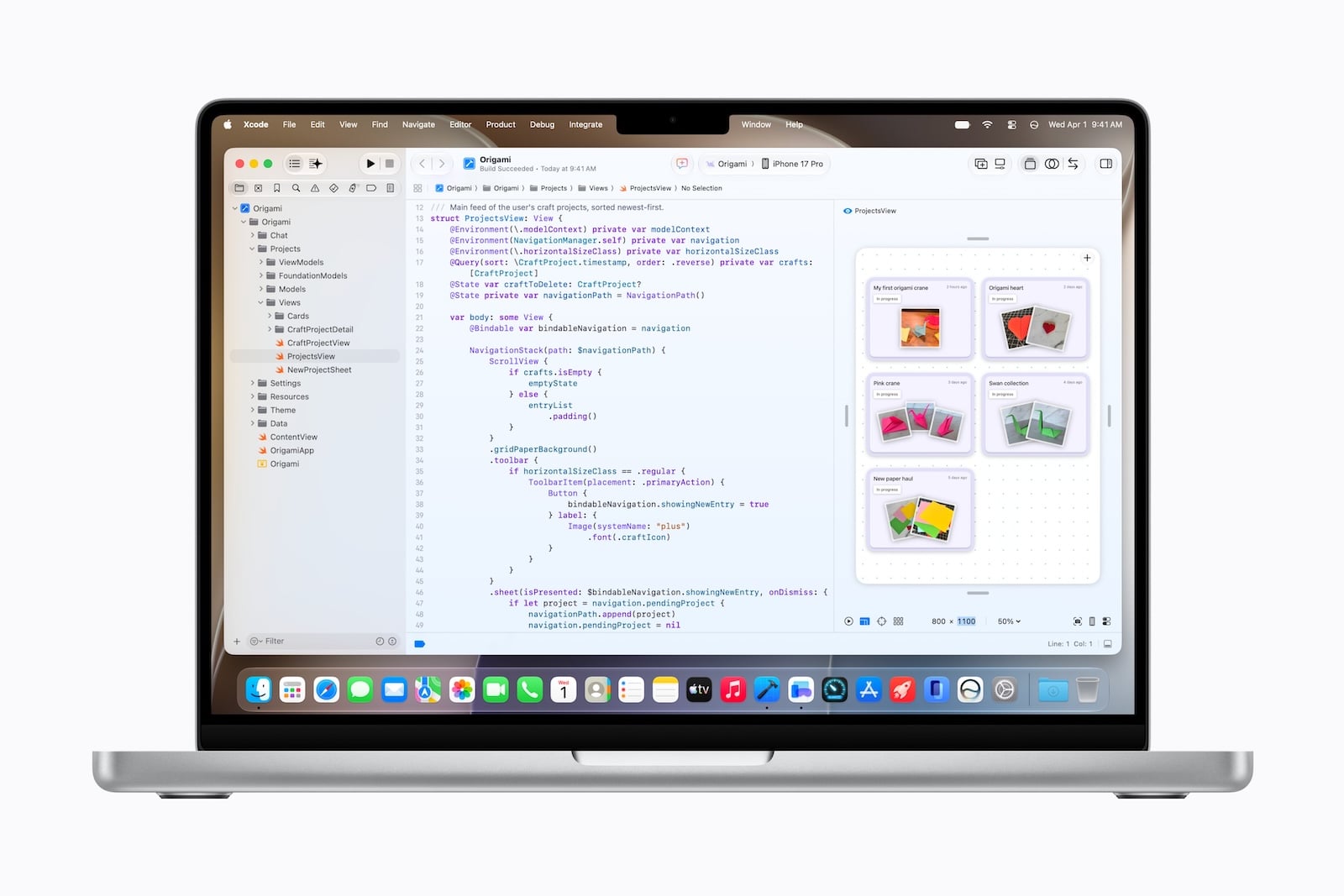
Xcode 27 and agent programming
Xcode 27 takes the next big step in agent-based programming, bringing the best models and agents from Anthropic, Google, and OpenAI directly into the workflow. Conversations with the coding agents offer interactive planning, multi-stage feedback, and a workspace that displays Markdown, along with code changes and previews right next to it.
Agents can review their own work and thus run independently for longer periods – for example, by writing and executing tests, trying out ideas in isolation in Playgrounds, checking visual changes via previews, and interacting with the simulator in the new Device Hub. Xcode can be extended with custom capabilities via plugins: everyday tools can be integrated via the Model Context Protocol, and any agent that supports the Agent Client Protocol can be connected. GitHub and Figma are the first to offer seamless installation between their tools and Xcode.
Furthermore, Xcode 27 is now pure Apple Silicon software, 30 percent smaller and faster, with simpler setup. The interface is more customizable than ever, with a freely configurable toolbar and a new theme system that applies colors to the entire editor. Xcode Cloud now runs up to twice as fast and, for the first time, supports Metal apps as well as visionOS builds, powered by Apple Silicon.
Enhanced design as well as SwiftUI and Swift
The unified Liquid Glass design continues to evolve, with improvements in readability, adaptability, and consistency. A new transparency slider in the settings allows users to customize the display to their liking, and the design seamlessly adapts to selected accessibility settings. This refinement continues the previously anticipated design adjustments to the Liquid Glass look.
SwiftUI makes apps more responsive without requiring developers to change their code—through more efficient state initialization and faster layout rendering. New, reorderable containers reduce the amount of custom code required, and the new spatial preview framework allows users to view 3D models from Mac apps spatially when streamed to the Apple Vision Pro. Swift itself, in version 6.4, simplifies everyday tasks with targeted warning suppression, simplified availability attributes like "anyAppleOS," and improved compiler diagnostics.
New tools for games
New tools are also available for game and spatial developers. Managed Background Assets reduce game installation sizes through intelligent, language-based delivery: The system automatically detects the player's preferred language and downloads only the necessary asset packages, using the closest match. A new Steam Asset Converter also simplifies the adaptation of PC games for iOS, iPadOS, macOS, tvOS, and visionOS.
Game Porting Toolkit 4 accelerates Mac game development with open-source agent capabilities that leverage Apple's Metal development best practices. Official Unity plug-ins bring native Apple integration to one of the most popular game engines: Apple provides plug-ins for StoreKit and background assets, enabling cross-platform in-app purchases within the familiar Unity workflow. Reality Composer Pro 3 lets you build complete spatial experiences in a single tool; new live previews, combined with the Mac Virtual Display, instantly show the results of changes.
Apple's developer offensive is taking shape
Developer betas for iOS 27, iPadOS 27, macOS 27, watchOS 27, tvOS 27, visionOS 27, and Xcode 27 are available starting today through the Apple Developer Program; Apple Intelligence features remain limited to supported regions. Overall, Apple is significantly shifting the focus for developers toward AI—from open model interfaces and agent-based tools in Xcode to locally running language models. This is accompanied by the concurrently announced new App Store features for developers, which focus more on marketing and new business models. Together, these developments paint a picture of a platform that more closely integrates developers with its AI infrastructure. (Image: Apple)
- tvOS 27: These are the new features for Apple TV
- iOS 27, macOS 27 and more: Apple launches the Developer Betas
- App Store: Apple gives developers new tools
- Apple expands parental controls with new features
- Siri AI in the EU: DMA delays launch on iPhone and iPad
- Apple Intelligence: The next generation is here
- Siri AI: Apple introduces the completely redesigned assistant
- Tim Cook gets in the mood for WWDC with a "Good Morning" video.
- Gemini could become the upper limit for Apple's AI ambitions
- UK is demanding that Apple implement a feature that already exists
- UK threatens tech executives with jail if children can see nude images
- Epic Games counters Apple's move before the Supreme Court
- Apple Arcade: Nine new games in June and July
- App Store: Ecosystem reaches $1.4 trillion
- Apple TV shows the trailer for "Lucky" starring Anya Taylor-Joy
- Apple opens Europe's first Developer Center in Berlin
- Apple discloses revenue figures in India antitrust dispute
- Microsoft is ending Office support for older Macs and iPhones
- Musk must hand over Tesla and SpaceX emails in accordance with Apple's procedure
- Vision Pro Stylus: Apple patent aims to make virtual textures tangible
- MacBook Neo is selling better than the new MacBook Air and Pro
- Apple Design Awards 2026: The twelve winners have been chosen