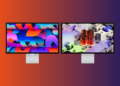
Apple has introduced two new monitors: the second-generation Studio Display and the Studio Display XDR. Both displays belong to Apple's professional product line and are aimed at users who expect high image quality, powerful hardware, and advanced camera and audio features.
In its official press releases and marketing materials, Apple does not specify which processors are used in the new displays. These details only became known by examining the devices' firmware. This information provides a more precise insight into the technology behind the new Apple monitors.
The chip information comes from the current firmware of the new Studio Displays. This was analyzed by MacRumors.
This analysis reveals that Apple is using different chips in the two new displays. Previously, rumors circulated that either the A19 chip or the A19 Pro chip might be used. The firmware now shows that Apple is using both processors and distributing them between the two models.
Different chips in the two Apple Studio Displays
According to the firmware, the second-generation Studio Display has an A19 chip. The Studio Display XDR, on the other hand, is equipped with an A19 Pro chip.
This information was not mentioned in Apple's press release or marketing materials. Only through firmware analysis did it become clear which chips are actually installed in the new monitors.
The decision to use two different chips aligns with the positioning of the two devices. The Studio Display forms the base of the series, while the Studio Display XDR is intended as a more powerful model.
A look back at the original Apple Studio Display from 2022
The first Apple Studio Display, introduced in 2022, already featured its own chip. Apple used the A13 Bionic chip at that time.
The A13 Bionic chip was originally introduced in 2019 with the iPhone 11 series. Apple also openly communicated at the time that this chip powers the Studio Display. The processor in the display performs several functions, including:
- the Center Stage camera alignment
- Spatial Audio
- voice activation "Siri" and "Hey Siri"
The integrated chip allows the monitor to process certain tasks itself, instead of leaving them entirely to the connected Mac.
New chip generation: A19 and A19 Pro
The new displays rely on significantly more modern processors. The A19 chip and the A19 Pro chip were first introduced last year in the iPhone 17 models and the iPhone Air.
These chips belong to Apple's current generation of chips and are significantly more powerful than the older A13 Bionic. This additional performance is likely to play a key role in several functions of the new displays.
Improved speakers and audio
Both new Apple Studio Displays feature a six-speaker sound system. According to Apple, this system has been improved compared to the previous generation.
The manufacturer states that the new displays deliver 30 percent deeper bass. The new chips could help to control audio processing more efficiently and adjust the sound more precisely.
New camera features
The more powerful chips will likely also enable new camera features. These include the Desk View function. With Desk View, the camera can display two perspectives simultaneously:
- the face in front of the monitor
- a top view of the desk
This allows, for example, documents, notes or devices on the table to be shown during a video call, while the face remains visible.
Further details will only emerge through testing and teardowns
Many technical details about the new Apple Studio Displays are not yet fully known. Further information about the hardware used is likely to emerge only through upcoming reviews and teardowns.
Such investigations often reveal exactly how the devices are constructed and what additional components Apple has installed.
Pre-order and market launch
Both new displays are available for pre-order now. The official market launch is scheduled for Wednesday, March 11th.
- Studio Display vs. Studio Display XDR: All the differences
- Studio Display XDR: 120 Hz only with certain Macs
- Studio Display & Studio Display XDR without Intel support
Apple integrates powerful iPhone chips into its monitors
With the new second-generation Studio Display and the Studio Display XDR, Apple is updating its monitor lineup and simultaneously using more modern chips. The use of the A19 and A19 Pro chips demonstrates that Apple continues to utilize processors from the iPhone line to control functions directly within the display.
The new chips are expected to primarily support camera features, audio processing, and other intelligent functions. More precise details about the hardware and potential additional features will likely only become fully known through upcoming tests and teardowns. (Image: Apple / Apfelpatient)
- Subscription apps: Why only a few apps are growing strongly
- iOS 26.3.1 & Co.: Apple releases new updates
- Apple expands its portfolio with seven new devices
- MacBook Neo: 8 GB RAM as the biggest compromise
- MacBook Neo: Why the Mac only supports one monitor
- MacBook Neo: More recycled materials than ever before
- MacBook Neo: Two USB-C ports with important differences
- MacBook Neo: Touch ID is only available at an extra cost
- MacBook Neo: Apple's new entry into the Mac world
- iPhone Security: Dangerous exploit toolkit in circulation
- M4 iPad Air: First Geekbench results have surfaced
- Studio Display XDR supports DICOM medical images
- Apple is promoting Mac gaming at GDC 2026
- Studio Display XDR: 120 Hz only with certain Macs
- Studio Display & Studio Display XDR without Intel support
- OpenAI: GPT-5.3 enables better dialogue
- Meta Ray-Ban: Data privacy nightmare revealed
- The Pro Display XDR is being discontinued
- MacBook Air M5: What the new generation brings
- MacBook Pro with M5 Pro & M5 Max officially unveiled
- Apple M5 Pro and M5 Max: More power for professionals
- Apple presents Studio Display & Studio Display XDR
- Apple TV: No third season for Palm Royale
- Anthropic simplifies AI migration with import tool
- Where is the file located? Offline Files knows the answer instantly