
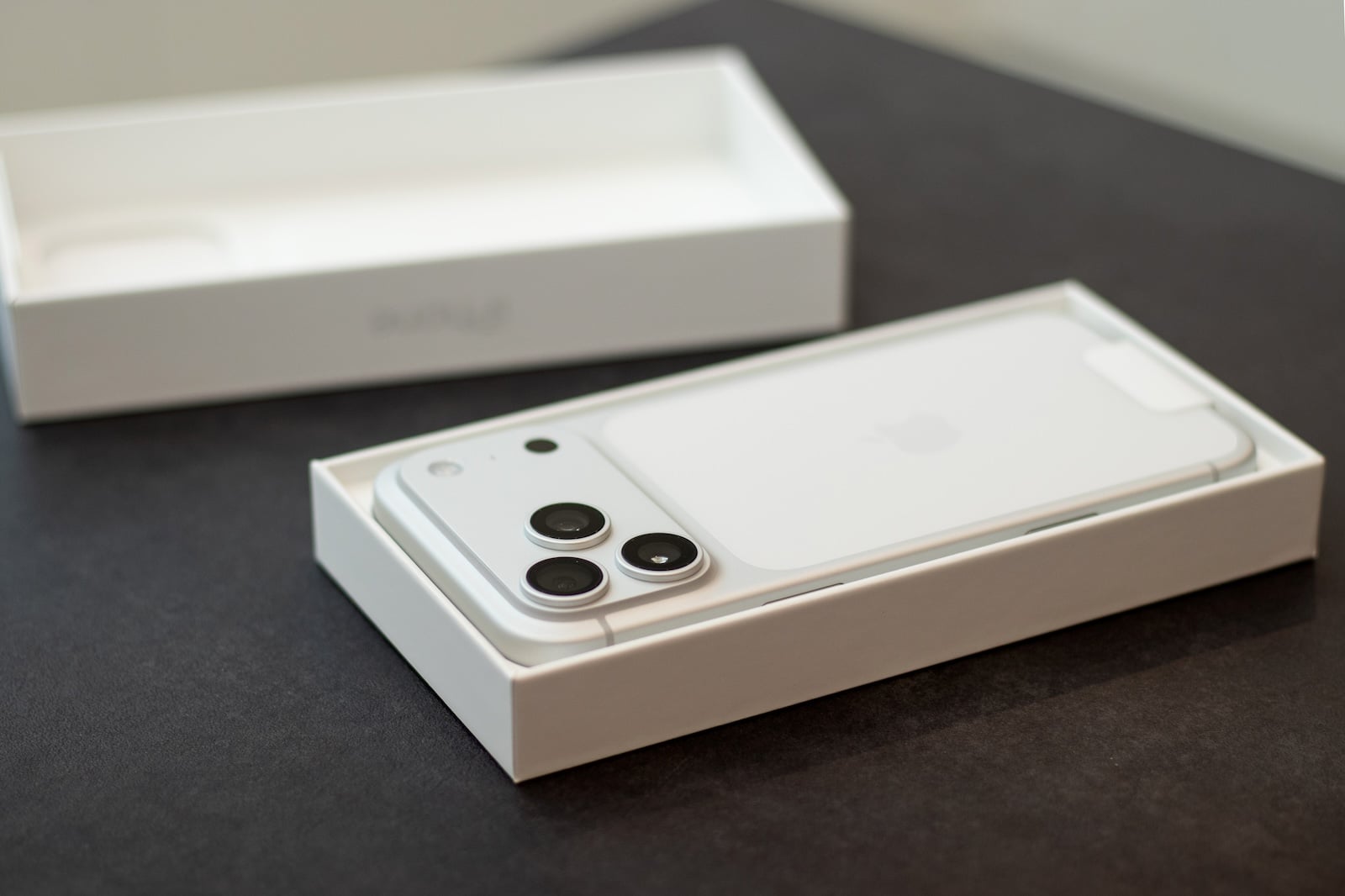
Apple achieved two records simultaneously in the first quarter of 2026: The company captured almost half of the global smartphone market, and the average price per iPhone sold climbed to $908 – also a Q1 high. The standard iPhone 17 and the iPhone 17 Pro Max were the driving forces behind this success.
The smartphone market is becoming increasingly unevenly distributed financially. While Apple has long marketed unit sales and its premium position separately, the latest Counterpoint Research report reveals just how far this revenue advantage has now extended. In the first quarter of 2026, Apple achieved a share of global smartphone revenue that no single manufacturer has ever achieved in a first quarter – while simultaneously driving its average selling price even higher. This data reinforces the picture that was already emerging with the iPhone 17 as the best-selling smartphone of the quarter. Thus, success in unit sales is becoming a resounding financial success.
Almost every second dollar goes to Apple
Apple accounted for 48 percent of global smartphone sales in the first quarter of 2026. In the same quarter of the previous year, this figure was 43 percent. This also makes the company the fastest-growing smartphone brand in annual revenue. Samsung follows in second place with 18 percent, followed by OPPO – including OnePlus and realme – at six percent, Xiaomi at five percent, and vivo at four percent. In terms of unit sales, Apple and Samsung are tied with a 21 percent market share each. The difference in revenue share illustrates the extent to which Apple financially dominates the premium segment: The company retains significantly more profit per device sold than its competitors.
Average price reaches $908
The second record concerns the average selling price. Apple's ASP rose to $908 in the first quarter of 2026 – an all-time high for a first quarter. What's remarkable is the consistency of iPhone prices. Apple kept prices largely unchanged, while competitors like Samsung had to adjust them upwards due to the global memory shortage. The overall smartphone market saw a 12 percent increase in ASP to $399 – an effect of rising material costs, especially in memory. Apple was largely able to absorb these cost increases, further strengthening its competitive position.
Asia-Pacific is driving growth
Geographically, Apple's strength is particularly evident in the Asia-Pacific region. Subsidies from mobile carriers, targeted promotional campaigns, and attractive trade-in programs have significantly accelerated iPhone 17 sales in China, India, and Japan. These markets have become some of Apple's most important growth drivers. The fact that the standard iPhone 17 is particularly well-received there as a value-for-money model is also changing the product mix: Apple is not only selling Pro models at a higher price but is also bringing more customers into its ecosystem who can later upgrade to higher-end models. The results of the current quarter thus fit seamlessly into Apple's previously confirmed Q2 success and the five specific reasons for the iPhone 17's success that Tim Cook cited to investors during the earnings call.
The market environment remains fragmented
Counterpoint Research expects global unit sales to continue declining in 2026. At the same time, average prices are likely to rise further – an effect fueled by the ongoing storage shortage. Analysts anticipate a noticeable market recovery only towards the end of 2027. Paradoxically, this is a favorable situation for Apple: as the mass market shrinks and budget devices become more expensive, the price argument against the iPhone weakens further. The premium segment inevitably becomes the most attractive zone, and Apple holds by far the largest position there. The first-ever Q1 market leadership in unit sales, which Apple achieved at the beginning of 2026, takes on a second, financial dimension with the recently released revenue figures.
A quarter that further cemented Apple's position
With the latest report, the balance between unit sales and value creation in the smartphone market shifts once again in Apple's favor. While its direct competitors battle for market share in a declining volume market, Apple sets the financial benchmark. The iPhone 17 cycle is thus having a longer-lasting impact than many analysts anticipated at the beginning of the year – and is laying the groundwork for the upcoming Pro models, which are expected to be released in the fall. How the market mix will change once the iPhone 18 Pro, iPhone 18 Pro Max, and the first foldable iPhone expand the Pro lineup should become apparent as early as the fourth quarter of 2026. (Image: Shutterstock / Tatjana Meininger)
- Supreme Court rejects Apple's emergency motion: Epic case goes back to the lower court
- Disney+ is becoming a super app: Streaming is just the beginning
- Apple TV conquers Broadway: Twelve Tony nominations for "Schmigadoon!"
- Mac Studio M3 Ultra: Apple removes the last RAM upgrade option
- GPT-5.5 Instant: New standard model for ChatGPT with significantly fewer hallucinations
- watchOS 26.5: Apple fixes two Apple Watch bugs and introduces a new Pride watch face
- Apple is exploring Intel and Samsung as chip alternatives to TSMC
- Apple Manufacturing Academy: First major event showcases AI in everyday factory operations
- Apple appeals to the Supreme Court: Emergency motion in the Epic case
- The iPhone 17 is the world's best-selling smartphone
- iOS 26.5 RC prepares for sideloading in Brazil
- OpenAI brings ChatGPT for Intune to the App Store
- Apple confirms end-to-end encryption for RCS in iOS 26.5
- iOS 26.5 Release Candidate: Final version is imminent
- Mac shortages persist: Hope rests on TSMC's 2-nanometer chips
- Apple unveils the new Pride Collection 2026
- Apple escalates dispute with India's antitrust authority
- WhatsApp is working on Liquid Glass for the chat interface
- Apple Hearing Study: New insights into hearing health
- Apple discontinues 256GB version of the Mac mini
- Tim Cook cites five reasons for the iPhone 17's success
- Apple CFO hints at delay in next iPad