For the first time in years, Apple is apparently seriously considering distributing its chip production across more than one manufacturer. According to a new Bloomberg report, early talks are underway with Intel, and Apple has simultaneously inspected a Samsung factory in Texas. Two chip alternatives, a clear motive – and a detail that could be relevant for iPhone and Mac buyers.
The news comes at a doubly sensitive time for Apple. On the one hand, the company has just completely restructured its hardware organization under Johny Srouji as Chief Hardware Officer, with a dedicated silicon division headed by Sri Santhanam. On the other hand, supply chains for modern chips are tighter than ever before – the global memory crisis, which recently put pressure on the 2026 notebook market, demonstrates how vulnerable even the world's largest semiconductor buyer can be. Bloomberg reporter Mark Gurman and his team now report that Apple is combining these two insights and seriously considering how to reduce its dependence on the Taiwanese contract manufacturer TSMC.
What exactly is being reported
According to Bloomberg, the talks are in their early stages. Initial exploratory talks are underway with Intel, and Apple has already visited a Samsung Electronics facility in Texas where advanced chips are reportedly manufactured. Importantly, no orders have yet been placed, and Bloomberg reports that Apple also has concerns about whether non-TSMC technology can deliver the necessary quality. Therefore, no switch to TSMC has been explicitly announced, but rather this is a strategic preparation.
The background is both sobering and dramatic. Apple has developed its own chip architecture for over a decade – but the manufacturing of the A and M series is almost entirely outsourced to TSMC. Currently, iPhones and Macs run on 3-nanometer processes that are only available there. Bloomberg reports that Apple itself recently acknowledged the "limited flexibility" of its supply chain in its latest earnings call. The pressure stems primarily from the AI boom: data centers are siphoning off semiconductor capacity, while at the same time, demand is rising for Macs that can run AI models locally.
Why Intel and Samsung – and why now
The choice of candidates is no coincidence. Under its new CEO, Lip-Bu Tan, Intel is working on its own foundry division, essentially contract manufacturing for other companies. An Apple contract would be the ultimate validation coup for this strategy. There's also a political dimension: the US government has held a 10 percent stake in Intel since 2025. A collaboration with Apple would therefore also have significant geopolitical implications – and aligns with Apple's involvement in the American Manufacturing Program and its new Manufacturing Academy.
Samsung Electronics, on the other hand, has the most advanced foundry business after TSMC, but lags behind technologically. An Apple contract would enhance Samsung's position relative to the industry leader from Taiwan. Apple, in turn, would secure a second potential supplier of high-quality chips without terminating its relationship with TSMC.
The real trigger, however, is not economic but geopolitical: the ongoing tensions between China and Taiwan pose a latent risk for TSMC. A company like Apple, which ships hundreds of millions of devices with TSMC chips annually, cannot afford a single point of failure. The threat surrounding TSMC has been part of the industry discussion for months, and from a risk management perspective, Apple absolutely must have a Plan B.
Three key findings from the report
A closer look at the Bloomberg report reveals three key conclusions that complete the picture.
First, the discussions are perfectly understandable. Apple has always preferred at least two competing suppliers for critical components – both for negotiating reasons and to minimize risk. The fact that this principle hasn't applied in the chip sector for years is more the exception than the rule. TSMC's dominance is a historical anomaly, not a desirable state of affairs.
Secondly, expectations should remain tempered. Both Intel and Samsung have been trying for years to catch up technologically with TSMC. The problem is that the bar is constantly being raised. For every advance made by the competition, TSMC raises the bar even further. Therefore, the most likely scenario remains that Intel and Samsung will initially only be able to manufacture chips for older Apple devices – similar to the TSMC plants in Arizona, which use older processes. For the high-end models, TSMC will remain the only viable option for the foreseeable future.
Thirdly – and this is where it becomes relevant for buyers: When different manufacturers produce the same chips, differences in quality are possible. In the past, Apple has had cases where displays from different suppliers varied in quality – LG was dropped as an LCD iPhone display supplier in 2021 because its quality couldn't compete with Samsung's. In the Android camp, the difference between Snapdragon chips manufactured by Samsung and those manufactured by TSMC was so significant that Qualcomm marketed the TSMC variant separately as the "Snapdragon 8 Plus".
What this could mean for iPhone and Mac buyers
This third point is precisely the critical one. If Apple were to source the same A or M chip from two different foundries in the future, performance or efficiency differences could arise between supposedly identical devices. In the worst-case scenario, buyers would then be faced with the question of whether the iPhone or Mac they purchased contains a TSMC or an Intel/Samsung chip – a scenario that contradicts Apple's otherwise meticulously controlled brand promise.
Apple is undoubtedly aware of this risk. This is precisely why the talks with Intel and Samsung are likely being conducted so cautiously, and why Bloomberg maintains that "Apple may not go any further" with alternative partners. Diversification will come, but it will be selective – probably starting with older chip generations for entry-level devices or with components where the performance differences are less significant.
Apple's steady hand in a grand strategy
What's becoming apparent here is a classic Apple approach: extensive preparation, quiet initiation, and only acting once the chain is complete. The reorganization of the hardware division under Srouji, the independent silicon division under Sri Santhanam, the expansion of US manufacturing with Bosch, TDK, and Cirrus Logic, the Manufacturing Academy in Michigan – all these elements combine to create a new picture of the Apple supply chain: less concentration, more resilience, and a significantly stronger US component.
The talks with Intel and Samsung are not a game-changer in this context, but rather part of a multi-year strategy. It will likely be years before an iPhone or Mac chip actually rolls off the production line outside of TSMC. But the fact that Apple is now visibly planning ahead is what's truly remarkable. In an industry that lives and breathes quarterly results, Apple is thinking further ahead than most others.
Apple's chip strategy is being reorganized
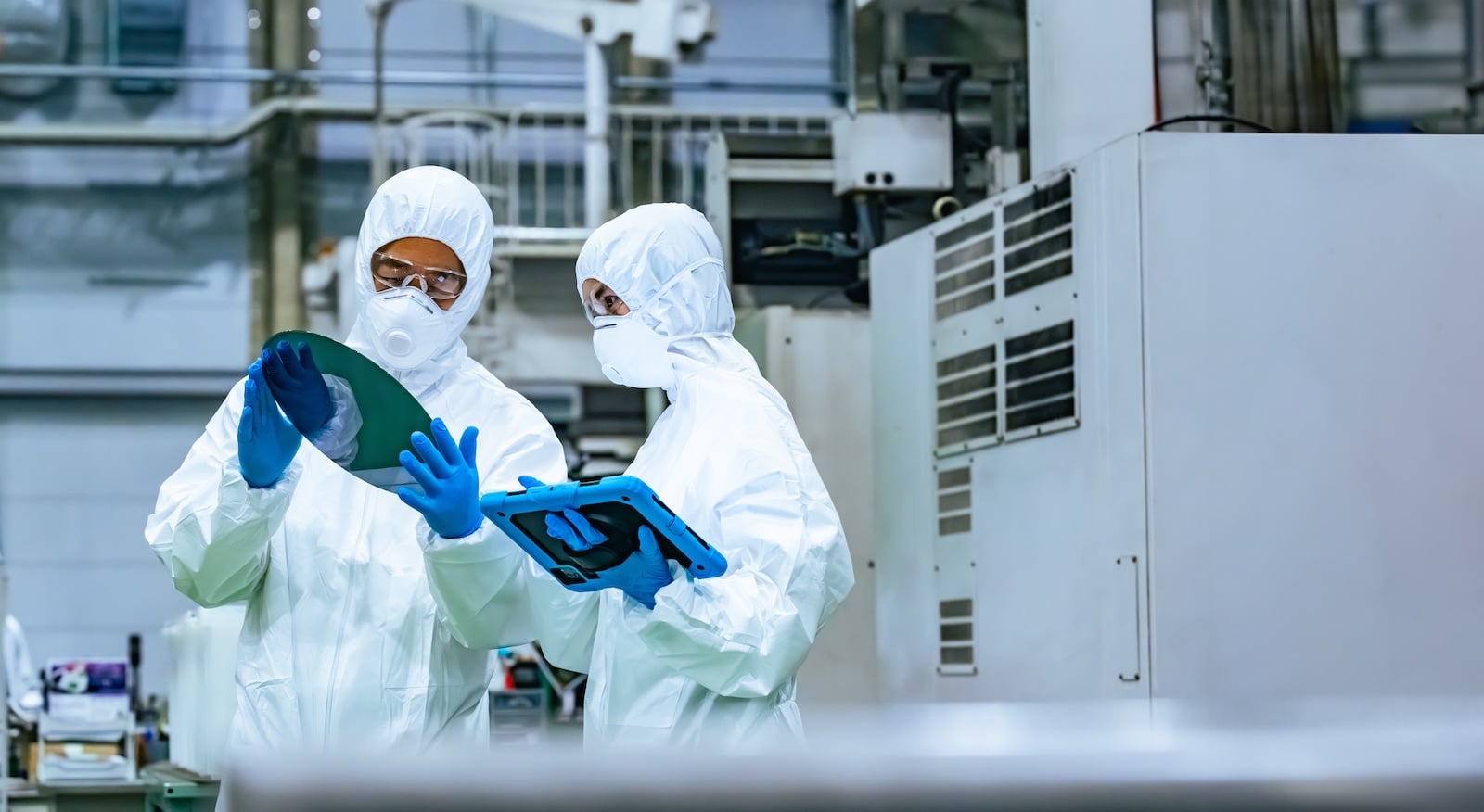
The Bloomberg report isn't a change, but rather an announcement of options. Apple will continue to have the majority of its chips manufactured by TSMC, especially the high-end chips for the iPhone Pro and Mac. However, the company is systematically building the capability to shift parts of its production – whether to Intel in the US or to Samsung in Texas. Buyers should keep in mind that if Apple takes this path, its communication will have to be very precise to prevent the "M-series chip" from suddenly becoming a lottery where the foundry's influence determines the final product. (Image: Shutterstock / metamorworks)
- Apple Manufacturing Academy: First major event showcases AI in everyday factory operations
- Apple appeals to the Supreme Court: Emergency motion in the Epic case
- The iPhone 17 is the world's best-selling smartphone
- iOS 26.5 RC prepares for sideloading in Brazil
- OpenAI brings ChatGPT for Intune to the App Store
- Apple confirms end-to-end encryption for RCS in iOS 26.5
- iOS 26.5 Release Candidate: Final version is imminent
- Mac shortages persist: Hope rests on TSMC's 2-nanometer chips
- Apple unveils the new Pride Collection 2026
- Apple escalates dispute with India's antitrust authority
- WhatsApp is working on Liquid Glass for the chat interface
- Apple Hearing Study: New insights into hearing health
- Apple discontinues 256GB version of the Mac mini
- Tim Cook cites five reasons for the iPhone 17's success
- Apple CFO hints at delay in next iPad
- Apple Q2 2026 Earnings Call: The most important details and division figures
- Apple applies for customs refunds – and plans reinvestment in the USA
- Apple Q3 2026: Guidance promises double-digit growth
- China business: Cook explains why Apple is gaining ground again
- John Ternus: First earnings call appearance as Apple's designated CEO
- iPhone 17: Apple's most popular lineup ever
- Mac lineup is booming: Cook confirms supply shortage of the Mac mini