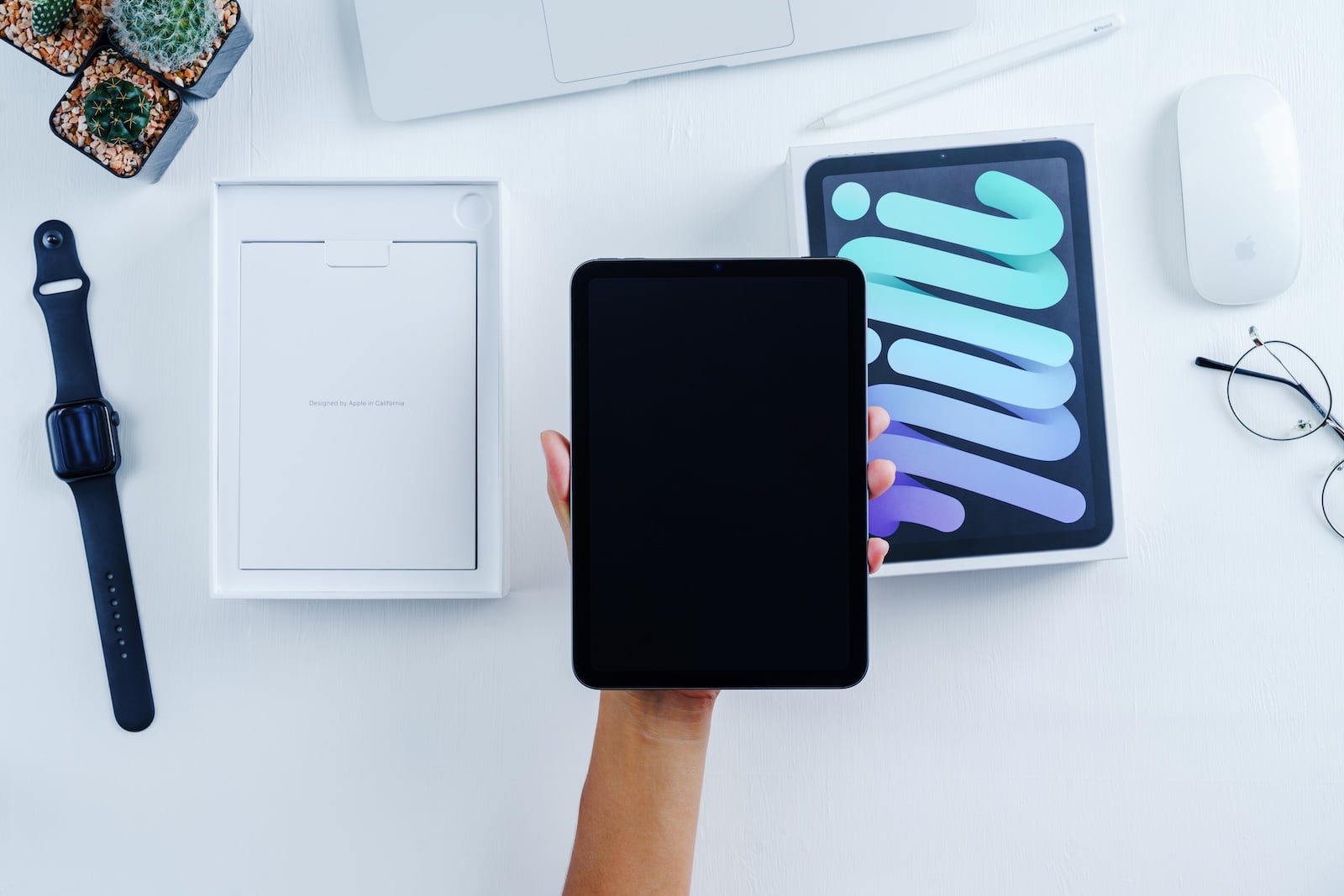
The iPad mini is about to receive its biggest upgrade since the 2021 redesign: for the first time, an OLED display, along with a significantly faster chip. However, rumors are pointing in an uncomfortable direction regarding the very question that many potential buyers are most concerned about – the refresh rate might remain at 60 Hz.
The current iPad mini (7th generation) arrived in October 2024 with the A17 Pro chip and Apple Intelligence support. A solid update, but the display hasn't changed since 2021: the small tablet still uses an LCD (Liquid Retina) instead of OLED. That's expected to change in 2026. Consistent reports from Bloomberg, DSCC, Samsung Display's supply chain, and several leakers indicate that the iPad mini 8 will be the next Apple device with an OLED panel. Choosing the right model in the current iPad lineup isn't easy anyway – the iPad mini 8 could significantly shift recommendations across the entire iPad range.
Key Facts at a Glance
Complete table with the new RAM row, ready to be copied directly into the WordPress table block:
| Detail | Expectation |
|---|---|
| Code name | J510 / J511 |
| Chip | A19 Pro (likely), A20 Pro (possible) |
| RAM | 12 GB expected (currently 8 GB) |
| Display | OLED, approx. 8.4–8.5 inches |
| Refresh rate | 60 Hz according to the latest leak, ProMotion unlikely. |
| Panel technology | Hybrid OLED with LTPS backplane (instead of LTPO like the iPad Pro) |
| Connectivity | N1 chip (Wi-Fi 7, Bluetooth 6), possibly C1X modem (5G) |
| Design | Largely unchanged, new colors possible |
| Water protection | For the first time expected |
| Release | Second half of 2026 (September/October) |
| Price | Currently from €549, with an expected surcharge of up to €100. |
Display: First OLED in the iPad mini
The OLED display is the most important new feature of the iPad mini 8. Samsung Display is supplying the panels, and mass production has already begun – a reliable sign that the schedule for the second half of the year is on track. Reports indicate an order for around two million panels; earlier figures from the fall mentioned up to three million. Samsung's involvement is not surprising: Samsung and LG are largely splitting Apple's OLED orders this year.
Current supply chain information indicates a panel size of approximately 8.4 inches, while DSCC analysts previously reported 8.5 inches – in both cases slightly larger than the current 8.3 inches, presumably due to narrower bezels. An earlier report even suggested 8.7 inches, which is now considered unlikely.
What OLED means for the iPad mini:
- Deep blacks and higher contrast (no backlight like with LCDs)
- Improved color accuracy (Wide Color P3)
- Thinner construction possible
- Higher energy efficiency
60 Hertz instead of ProMotion: the weak point
The crucial open specification is the refresh rate – and a Korean leaker reports a sobering figure: The iPad mini 8 is said to have a hybrid OLED panel with an LTPS backplane, clocked at a fixed 60 Hz. This would rule out ProMotion.
The difference between the panel generations determines the user experience. The iPad Pro models use a dual-layer tandem OLED display with an LTPO backplane, which can dynamically vary the refresh rate between 10 and 120 Hz. LTPS panels cannot do this, run at a fixed rate, and are generally somewhat dimmer. The iPad mini 8 would therefore not only have the lower refresh rate but also the weaker panel generation.
The claim isn't unfounded: A roadmap from market research firm Omdia, dating back to 2024, already indicated a 60Hz panel for the OLED iPad mini. Two independent references to the same result carry more weight than a single leak. However, one detail from the same report argues against a definitive confirmation: Production is reportedly taking place on Samsung's A2 line in Asan – where both LTPO and LTPS panels are manufactured. Therefore, the production location itself isn't sufficient proof of a 60Hz refresh rate.
The news still fits with Apple's strategy. The company consistently uses ProMotion as a feature to differentiate its higher-end models: The iPhone 17e continues to use OLED with a fixed 60Hz refresh rate, and ProMotion is also expected to be omitted from the iPhone 18e. The iPad mini is the smallest niche in the iPad lineup – a more expensive panel would have to be profitable there.
Even in the worst-case scenario, the leap is still noticeable: The iPad mini 7 currently displays an LCD with a 60Hz refresh rate. An OLED with the same refresh rate would offer higher contrast, true blacks, and better energy efficiency. The step wouldn't be disappointing compared to its predecessor, but rather compared to the expectations that have built up after two years of waiting.
Chip: A19 Pro – or even A20 Pro?
Leaked Apple code identified the iPad mini 8, codenamed J510/J511, as using the A19 Pro chip – the same chip found in the iPhone Air and iPhone 17 Pro. It's likely Apple is using the mid-tier variant with one fewer GPU core than the iPhone 17 Pro.
There are also indications of a possible A20 Pro (2 nm, TSMC). This would be unusual, as Apple doesn't always equip the iPad mini with the latest chip. If the iPad mini 8 is indeed released in October 2026 – after the iPhone 18 Pro – Apple could opt for the newer chip.
Regarding RAM, a leaked motherboard suggests 12 GB – four more than the current iPad mini 7 with 8 GB. This increase matches the A19 Pro chip and provides reserves for the on-device Apple Intelligence features that iPadOS 27 expands system-wide.
Connectivity: Wi-Fi 7 and 5G
The iPad mini 8 is expected to receive the N1 chip for Wi-Fi 7, Bluetooth 6, and Thread – a significant upgrade over the current Wi-Fi 6E. Apple's own C1X modem for 5G is likely for the cellular models.
Design and water protection
The basic design is unlikely to change much: flat edges, Touch ID integrated into the power button, USB-C. New colors are probable. The thinner OLED panel could allow for a slightly slimmer casing.
An exciting new feature: The iPad mini 8 is set to be water-resistant for the first time – a first for an iPad. Details regarding the IP rating are not yet known. This is made possible by a new speaker system with vibration technology that eliminates traditional speaker openings, thus reducing the surface area of the casing susceptible to water and dust.
Apple Pencil and camera
Support for the Apple Pencil Pro will remain. No major changes are expected with the cameras – the 12MP wide-angle rear camera and the 12MP front camera are likely to stay. It's possible the front camera will move to the landscape side, as with other iPads.
Release and price
The iPad mini 8 is expected in the second half of 2026 – most likely September or October. Recent supply chain reports narrow the timeframe to an October launch. Leaker Instant Digital cites "H2 2026 at the earliest" as the timeframe. The fact that panel production is already underway further supports this timeline.
The crucial figure regarding price is already on the table: When Apple raised prices for Macs, iPads, and other products at the end of June, the iPad mini was left out. In Germany, it remains at €549 (128 GB, Wi-Fi), €679 for 256 GB, and €929 for 512 GB; in Switzerland, it starts at 499 Swiss francs. However, the increased storage costs, which have made the iPad Pro and iPad Air €150 to €200 more expensive each, also affect the successor – and on top of that, there's the more expensive OLED panel. A price increase of up to €100 is expected, bringing the starting price to around €649. Gurman, however, has noted that Apple is considering a more affordable entry-level model.
Who is the iPad mini 8 intended for?
Anyone using a 6th generation (2021) or older iPad mini will get a completely new experience with the iPad mini 8: OLED display, significantly faster chip, Apple Intelligence and Wi-Fi 7. It's almost always worth the wait.
The situation is different with the current iPad mini 7 (2024). The A17 Pro is still powerful, Apple Intelligence is already running, and if the 60Hz leak is confirmed, the argument many had hoped for disappears. What remains is the OLED panel itself – a real advantage for readers, TV series enthusiasts, and anyone using the device in the dark, but not for smoother scrolling.
How much importance you place on the refresh rate depends on your intended use: Those who primarily read and stream will hardly miss 60 Hz. Those who draw, scroll a lot, or have an iPad Pro nearby will notice the difference immediately. Nevertheless, our recommendation remains: If you're planning on getting a new iPad mini anyway, you should wait until fall 2026. Buying the previous model shortly before the OLED switch makes no sense.
The best products for you: Our Amazon storefront offers a wide selection of accessories, including those for HomeKit. (Image: Shutterstock / blackzheep)
- iPhone 20: All the rumors about the anniversary model
- Apfelpatient Weekly #14
- The Mail app in iOS 27: All new features at a glance
- iPhone Ultra (iPhone Fold): All rumors and facts at a glance
- iPhone 18 Pro: All the rumors at a glance
- CarPlay in iOS 27: All new features at a glance
- Why the iPhone will not be affected by the EU's 2027 replaceable battery requirement
- Apple Ring: All the rumors at a glance
- iPhone Air 2: All the rumors at a glance
- Apfelpatient Weekly #13
- Apple Watch Series 12: All the rumors at a glance
- AirPods Ultra: All the rumors at a glance