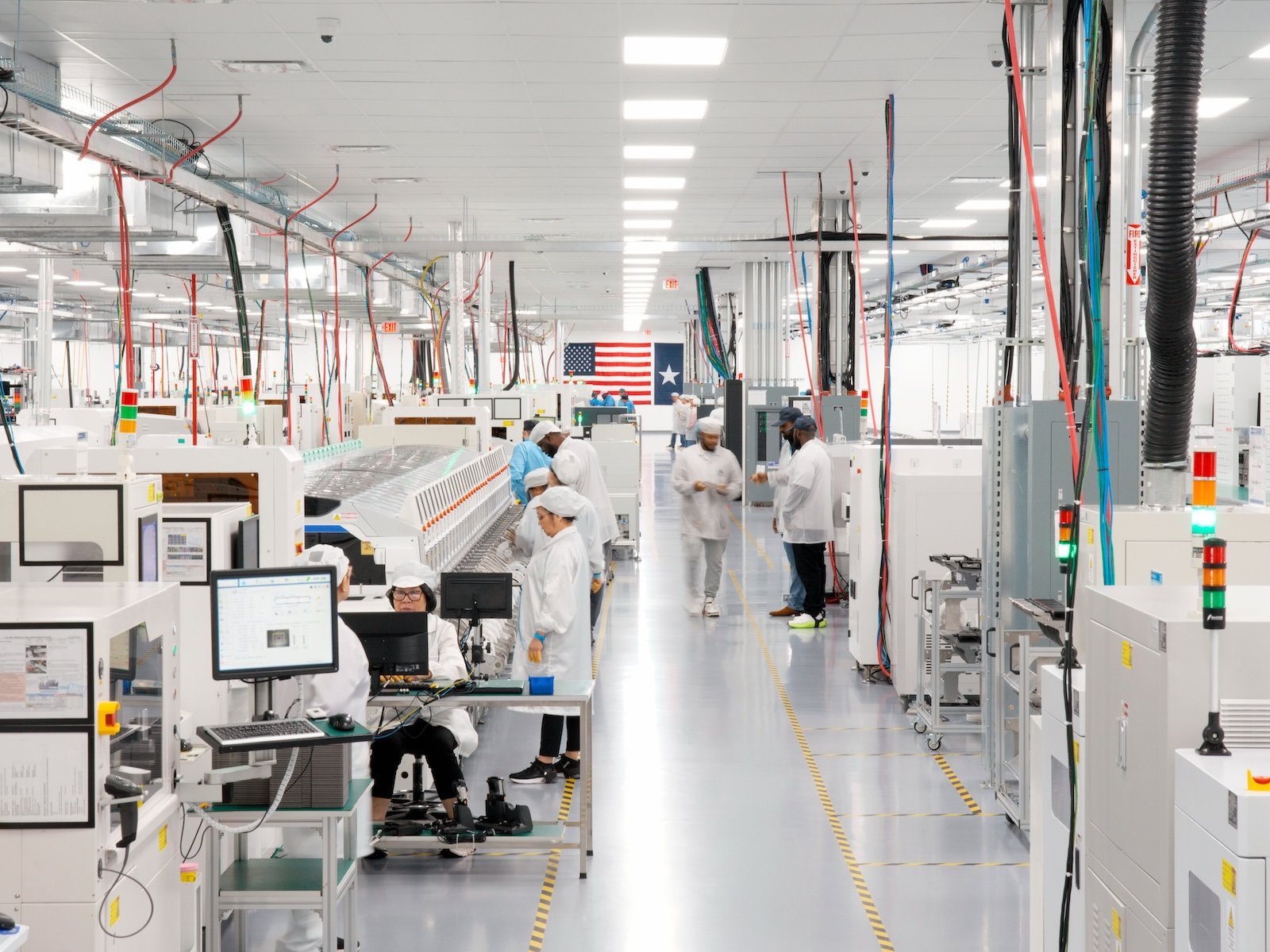
Apple is continuing to expand its production in the United States. This week, it announced that manufacturing in the US will be accelerated. This includes the production of certain Mac mini models, which are slated to be moved to the US later this year.
In parallel, Apple is providing, for the first time, a detailed look into its own chip manufacturing in the USA. This is based on a report by the Wall Street Journal, which gained access to several partner factories and documented the individual steps of the supply chain.
Wall Street Journal journalist Rolfe Winkler reports that Apple took him on a tour of its partner factories to demonstrate the "rebirth of the chip supply chain in the USA." Earlier this week, the Wall Street Journal reported that Mac mini production would be moved to the United States later this year.
The new article goes significantly further. It describes in detail the various stages of chip production in the USA and provides step-by-step details of the manufacturing process. The following locations were visited:
- GlobalWafers America's new factory in Sherman, Texas
- TSMC's chip factory in Arizona
- the Foxconn plant in Houston, Texas for final assembly
The full report is available through a subscription to the Wall Street Journal or via Apple News+. It includes numerous photos and detailed descriptions of each production step.
The beginning of the supply chain: Silicon processing in Texas
The supply chain begins at GlobalWafers America in Sherman, Texas. There, purified silicon rocks are processed, which are mainly extracted from sand deposits in North Carolina.
In the plant, these rocks are melted at approximately 2,500 degrees Fahrenheit. A perfect silicon crystal is then created in a machine about 35 feet tall, called a crystal puller.
The machines grow the silicon into cylindrical ingots that can weigh several hundred pounds. These massive cylinders form the basis for subsequent chip production.
In the next step, the ingots are cut into 12-inch wafers using a wire saw. Trillions of transistors will later be deposited onto these wafers to produce high-performance chips.
After being cut, the wafers pass through several machines. They are polished, tested, and finally packaged. Only then are they forwarded to the next station in the supply chain.
Chip manufacturing in Arizona
The next stage of Apple's chip manufacturing in the USA takes place at TSMC's factory in Arizona. This is where the actual production of the chips occurs.
In highly controlled cleanroom environments, the prepared silicon wafers are equipped with complex circuits. Modern manufacturing equipment is used to precisely transfer the tiny transistor structures onto the wafers.
The report describes in detail how highly automated this process is. Only a few employees were visible during the tour. Robots and automated systems handle the majority of the work.
The relocation of chip production is therefore not primarily intended to create a large number of jobs. Instead, it is about strategic competitiveness and securing a critical industry.
Final assembly in Houston
After the chips are manufactured, final assembly takes place at the Foxconn plant in Houston, Texas. There, the produced chips are integrated into further components and prepared for use in end products.
This station represents the final step within the US-based supply chain. It demonstrates that Apple consolidates not only individual manufacturing steps, but several phases of the value chain in the United States.
Strategic background
A key aspect of the report is the strategic motivation behind the initiative. The US is not trying to bring back the semiconductor industry to create mass employment. Production is highly automated, which is why relatively few employees work on-site.
Instead, the focus is on addressing a strategic vulnerability. Global chip manufacturing is highly concentrated, particularly in Taiwan. This dependence is increasingly seen as a risk.
In this context, the report also refers to a recent New York Times article about a CIA briefing by Tim Cook on Taiwan. This context makes it clear that chip production is no longer just an industrial issue, but also has a security policy dimension.
Apple is strategically advancing chip manufacturing in the USA
Apple is accelerating production in the US and, among other things, is relocating the manufacturing of certain Mac mini models to the country. At the same time, the company is making transparent how chip manufacturing actually works in the US.
From silicon processing at GlobalWafers America to chip manufacturing at TSMC in Arizona and final assembly at Foxconn in Houston, a largely integrated supply chain is created.
The Wall Street Journal report details how complex, automated, and strategically important Apple's chip production in the US has become. (Image: Apple)
- App Store to dominate gaming market in 2025
- Samsung Galaxy S26 series officially unveiled
- Adobe Firefly uses AI to create a rough cut
- Apple Borivali: New Store opens in Mumbai
- Apple acquires AI startup for optics and photonics
- Ted Lasso Season 4: Release date finally confirmed
- Apple tightens age verification in the App Store
- Discord revises controversial age verification
- Apple Vision Pro: Behind the scenes of visionOS 26
- Apple Card before switch: Why Chase is optimistic
- Reddit & Discord: Controversy surrounding age verification
- Apple TV unveils trailer for season 5 of For All Mankind
- Apple shareholders clearly follow management
- Apple: Why iOS leaks are so rare
- iPhone to break sales record in Europe in 2025
- Apple was warned by the CIA about the risk in Taiwan
- Apple offers a glimpse into its Mac mini factory in Texas
- Apple will now manufacture the Mac mini directly in the USA
- Apple introduces Sales Coach app for iPhone & iPad
- iOS 26.4 Beta 2: All features and adjustments
- WhatsApp is working on scheduled messages
- David Pogue offers insights into "Apple: The First 50 Years"