
With the new 14-inch and 16-inch MacBook Pro, Apple is launching a generation that improves in almost every area. At its core are the new M5 Pro and M5 Max chips, which significantly accelerate both traditional computing power and on-device AI. These are complemented by a noticeably faster SSD, larger standard storage capacities, new wireless technologies, and a battery life of up to 24 hours. The MacBook Pro is clearly aimed at professional users who work with complex workflows, process large amounts of data, or want to run AI models locally.
With the new generation, Apple is pursuing a clear approach: maximum performance without compromising efficiency. The MacBook Pro is not only intended to be faster than its predecessors, but also to enable new ways of working. The direction of development is particularly evident in the field of artificial intelligence. Neural accelerators in the GPU, high memory bandwidth, and optimized multithreaded architectures ensure that demanding AI applications can run directly on the device.
According to Apple, the new MacBook Pro is up to four times faster than the previous generation and offers features that no other laptop provides in this form.
New architecture: M5 Pro and M5 Max in detail
At the heart of the new MacBook Pro are the M5 Pro and M5 Max chips. Both are based on a newly developed Fusion architecture, which combines two dies in a system-on-a-chip. This design was conceived from the ground up for AI and demanding professional workloads.
The CPU has up to 18 cores. These include six super cores, among them what Apple claims is the world's fastest CPU core, as well as twelve new performance cores. The architecture is designed for energy-efficient multithreaded processes and achieves up to 30 percent faster performance compared to the previous generation.
The M5 Pro is suitable for complex workflows such as optimizing algorithms or managing very large photo libraries. The M5 Max goes even further and is aimed at users who, for example, perform complex simulations or implement extremely computationally intensive projects.
GPU with Neural Accelerators: Focus on AI
A key feature of the MacBook Pro is its new GPU architecture. Each GPU core has an integrated Neural Accelerator, resulting in a massive increase in AI performance.
Compared to the previous generation, AI performance is up to four times faster. Compared to M1 models, it can even be up to eight times faster. LLM prompt processing is up to four times faster than on the M4 Pro and M4 Max. AI image generation reaches up to eight times the speed compared to the M1 Pro and M1 Max.
Graphics performance also increases significantly. Compared to the M4 Pro and M4 Max, the increase is up to 50 percent. For motion designers, this means that complex 3D scenes can be edited in real time. VFX artists see effects immediately in the preview. AI researchers and developers can train their own models locally without relying on cloud infrastructure.
Additionally, an improved Neural Engine and the increased bandwidth of the shared memory support these workflows.
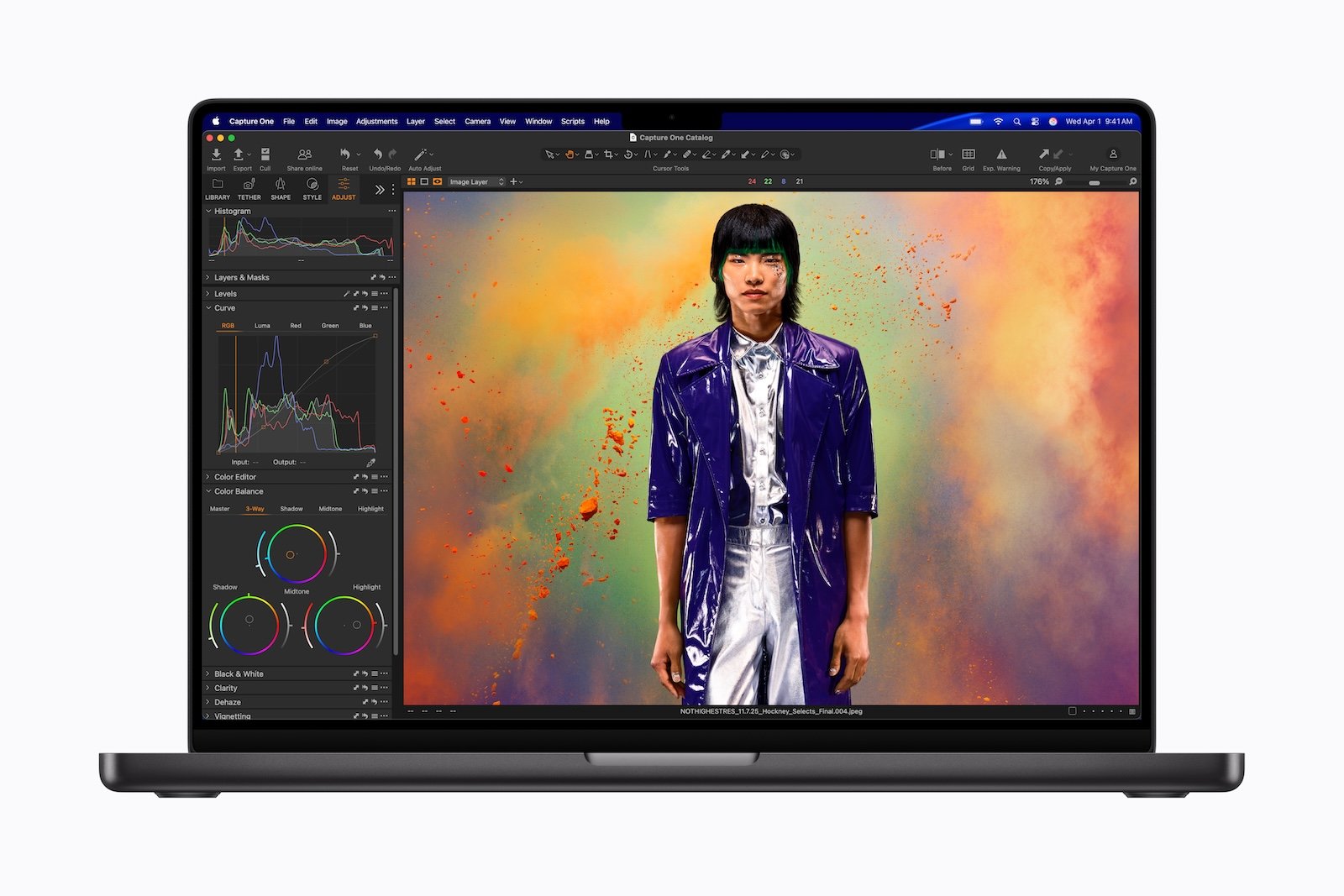
Concrete performance figures in practice
The performance leap of the MacBook Pro with the M5 Pro is clearly evident in the numbers. AI image generation is up to 7.8 times faster than on a MacBook Pro with an M1 Pro and up to 3.7 times faster than with an M4 Pro. LLM prompt processing is up to 6.9 times faster than with an M1 Pro and up to 3.9 times faster than with an M4 Pro. 3D rendering in Maxon Redshift runs up to 5.2 times faster than with an M1 Pro and up to 1.4 times faster than with an M4 Pro. When gaming with ray tracing, such as in Cyberpunk 2077: Ultimate Edition, performance is up to 1.6 times higher than with an M4 Pro.
On the MacBook Pro with M5 Max, AI image generation is up to eight times faster than on the M1 Max and up to 3.8 times faster than on the M4 Max. LLM processing reaches speeds up to 6.7 times faster compared to the M1 Max and up to 3.8 times faster compared to the M4 Max. Video effects in Blackmagic DaVinci Resolve Studio render up to 5.4 times faster than on an M1 Max and up to three times faster than on an M4 Max. In Topaz Video, AI video enhancement is up to 3.5 times faster than on the M4 Max.
More RAM and significantly higher bandwidth
The new MacBook Pro, with the M5 Pro chip, supports up to 64 GB of shared memory with a bandwidth of up to 307 GB/s. The M5 Max goes even further, enabling up to 128 GB of shared memory with a bandwidth of up to 614 GB/s.
These values are crucial for memory-intensive applications such as training large AI models, working with extensive datasets, or complex 4K and 8K video projects.
SSD performance and larger standard storage capacities
Another important point is storage performance. The MacBook Pro offers up to twice the read and write speeds of the previous generation. The SSD achieves speeds of up to 14.5 GB/s.
More storage is now offered as standard than before. The MacBook Pro with M5 Pro starts with 1 TB, and the model with M5 Max even comes with 2 TB. The 14-inch MacBook Pro with M5 also now comes standard with 1 TB of storage. This significantly reduces the need for external storage solutions, especially for large projects.
Battery life and fast charging function
Despite the increased performance, energy efficiency remains high. The MacBook Pro achieves a battery life of up to 24 hours. Upgrading from an Intel-based Mac can yield up to 13 additional hours of battery life. Upgrading from an M1 model can add up to three hours.
Performance remains consistently high whether the device is plugged in or running on battery power. With a 96W or more powerful USB-C power adapter, the device can be charged to 50 percent in approximately 30 minutes.
Display, ports and connectivity
The MacBook Pro features a Liquid Retina XDR display with up to 1,600 nits peak brightness for HDR content and up to 1,000 nits for SDR. Nanotexture glass is available as an option.
Connectivity options include three Thunderbolt 5 ports, HDMI with support for up to 8K resolution, an SDXC card slot, and MagSafe 3. The M5 Pro can connect up to two external displays, while the M5 Max can connect up to four.
A new Apple N1 chip enables Wi-Fi 7 and Bluetooth 6, providing improved performance and reliability for wireless connections.
Camera, audio and operating system
Features include a 12MP Center Stage camera with desktop view, studio-quality microphones, and a 6-speaker system with 3D audio support. This makes the MacBook Pro suitable for both professional video conferencing and media production.
Prices and availability
The new MacBook Pro can be pre-ordered starting March 4th on the Apple website and in the Apple Store app in 33 countries and regions. Shipping begins on March 11th, and the devices will also be available in Apple Stores and from authorized resellers at the same time.
In Germany, the 14-inch MacBook Pro with M5 Pro starts at €2,499, and the 16-inch model at €2,999. Education pricing starts at €2,329 and €2,779, respectively. The 14-inch MacBook Pro with M5 Max starts at €4,199, and the 16-inch model at €4,499. Education pricing is €3,849 and €4,169, respectively. The 14-inch MacBook Pro with M5 starts at €1,899, and €1,789 for education customers. All models are available in Space Black and Silver.
MacBook Pro with M5: Performance upgrade for AI and pro workflows
The new MacBook Pro with M5 Pro and M5 Max delivers noticeable improvements in CPU performance, graphics performance, AI acceleration, and storage technology. In particular, the integration of Neural Accelerators in the GPU and the significantly increased memory bandwidth make the device a platform for demanding AI and creative workflows.
At the same time, battery life, display quality, and connectivity remain at a professional level. For users upgrading from Intel or M1 models, this means not only increased speed but also a clear evolution of the MacBook Pro geared towards modern, AI-powered workflows. (Image: Apple)
- Apple M5 Pro and M5 Max: More power for professionals
- Apple presents Studio Display & Studio Display XDR
- Apple TV: No third season for Palm Royale
- Anthropic simplifies AI migration with import tool
- Where is the file located? Offline Files knows the answer instantly
- iOS 26.4 Beta 3 is here: Next step towards release
- Paramount plans mega streaming service with HBO
- Apple unveils new accessories for spring 2026
- Will an iPhone 16e case also fit the iPhone 17e?
- iPad Air with M4 is here: Here's what the update offers
- The iPhone 17e is here: Here's what's inside the new model
- Apple TV impresses at international award ceremonies
- Anthropic: Claude climbs to number 1 in the App Store
- Apple Stores in the UAE temporarily closed
- Anthropic: Why download numbers are exploding right now
- ChatGPT is approaching 1 billion users per week
- „"Steve Jobs in Exile": The book about humiliation and discipline
- Apple TV: Brazil is the second largest market
- Apple and the DRAM shortage in 2026 in focus
- Apple Watch will solidify its market leadership in 2025
- Apple officially launches Xcode 26.3
- Apple receives NATO approval for iPhone and iPad
- Apple TV expands "For All Mankind" with "Star City"