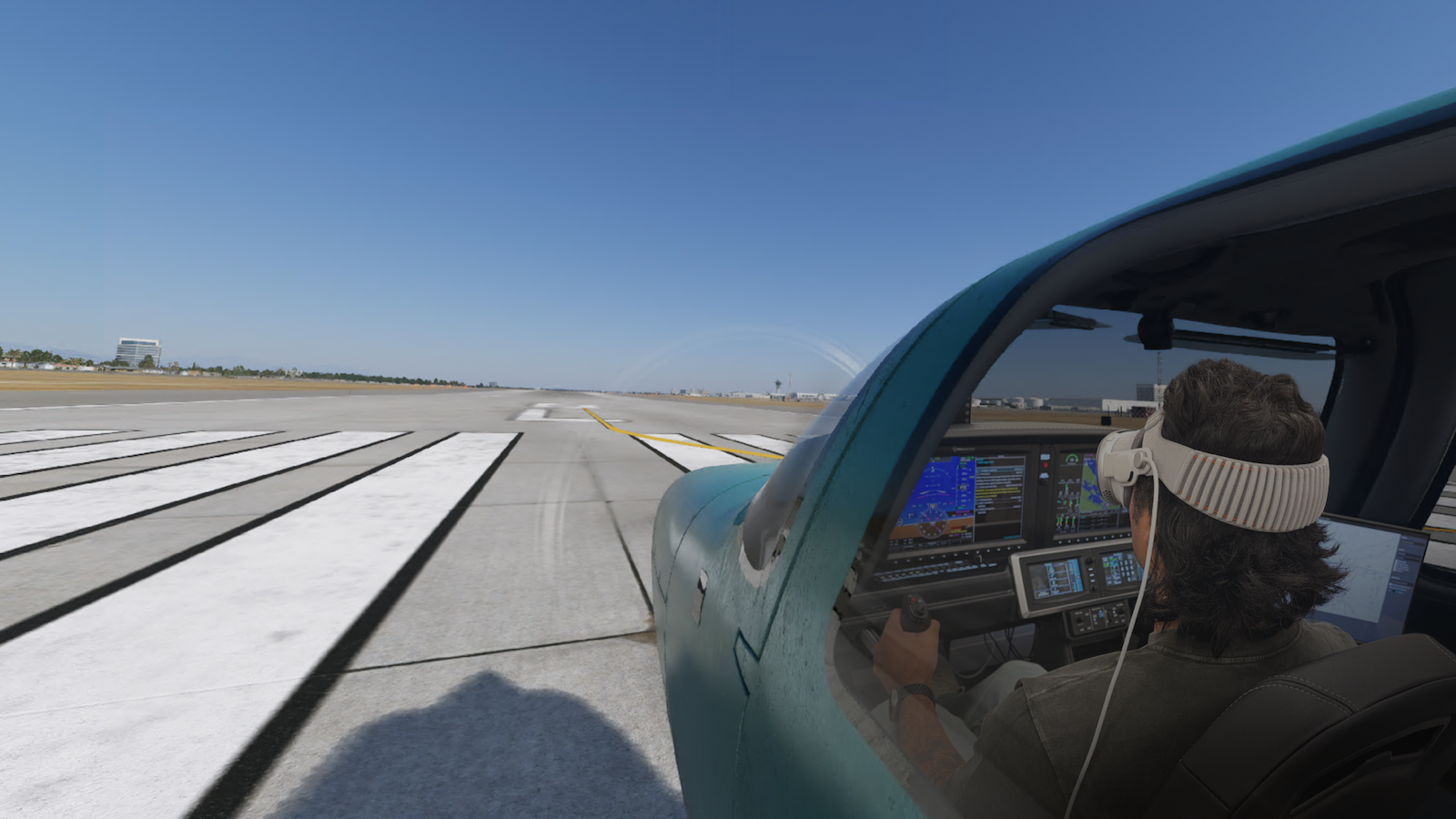
With visionOS 26.4, Apple Vision Pro receives a new feature that is particularly interesting for simulation and gaming enthusiasts. The upcoming software update will, for the first time, enable the use of one of the world's most technically demanding flight simulators on the headset.
The game in question is X-Plane 12, a simulator that was previously only available on traditional computer platforms. Thanks to new streaming technology, the program will soon be able to run on Apple Vision Pro as well. This opens up a new way to experience flight simulations: spatially, immersively, and directly in one's own environment.
Apple Vision Pro is based on the concept of spatial computing. Digital content is no longer displayed solely on flat screens, but appears spatially within the user's environment. This allows games, apps, and simulations to be significantly more immersive.
With visionOS 26.4, currently in beta, Apple significantly expands the capabilities of this platform. The update brings support for NVIDIA CloudXR 6.0, a streaming technology that can transmit powerful PC or cloud applications directly to the Apple Vision Pro.
This integration makes it possible to use complex simulations like X-Plane 12, even though they were originally designed for powerful computers.
X-Plane 12 is coming to Apple Vision Pro for the first time
X-Plane 12 is described by its developers as "the world's most advanced flight simulator." The software is known for its particularly realistic flight physics and detailed simulation of cockpit systems.
Previously, the simulator was only available for Mac, Windows, and Linux. With the visionOS 26.4 update, X-Plane 12 will also be usable on Apple Vision Pro for the first time.
This significantly expands the simulator's platform. Instead of playing on a monitor, the simulation can now be experienced in a spatial environment.
NVIDIA CloudXR 6.0 makes streaming possible
The key technical component behind this new feature is NVIDIA CloudXR 6.0. This technology enables the streaming of computationally intensive applications from powerful NVIDIA RTX systems or from the cloud to other devices. The actual processing takes place on a high-performance PC or server, while Apple Vision Pro simply receives and displays the image.
With visionOS 26.4, Apple Vision Pro officially supports this technology for the first time. This allows immersive PC and cloud-based applications to be streamed directly to the headset.
The development team behind X-Plane has confirmed that users should receive exactly this feature sometime this spring.
Companion app connects simulator and headset
To enable the use of X-Plane 12 on Apple Vision Pro, a companion app for visionOS will also be released. This app will be available in the App Store and will serve as a connection between the simulator and the headset.
The process is relatively simple. As soon as the app is launched, the flight simulator automatically detects the Apple Vision Pro. X-Plane 12 is then streamed directly to the headset.
The simulation itself continues to run on a compatible system with NVIDIA RTX hardware or via cloud servers. Apple Vision Pro handles the rendering of the environment and the cockpit.
ARKit connects real hardware with the virtual cockpit
A key component of this integration is the use of ARKit, Apple's framework for augmented reality. Using image recognition, the simulator can identify real-world elements in the cockpit and track their positions. This allows physical flight simulator hardware and virtual cockpit elements to be combined.
The system can, for example, recognize where real control units are located and correctly integrate them into the virtual environment. This creates a blend of physical and digital simulation.
Foveated Streaming with a focus on data privacy
CloudXR also supports privacy-enhancing foveated streaming. With this technique, the highest image quality is displayed only in the area that is currently being viewed. Areas outside the center of the field of view are transmitted with a lower level of detail.
This method reduces the required bandwidth while ensuring high image quality with low latency. At the same time, eye-tracking data remains protected, as it is not unnecessarily processed or stored.
Spatial computing is changing the way flight simulations are done
The combination of Apple Vision Pro, visionOS 26.4, CloudXR 6.0, and X-Plane 12 creates a new kind of flight simulation. Spatial computing allows the simulation to be experienced in three dimensions. The cockpit no longer appears solely on a screen but surrounds the player. In conjunction with existing flight simulator hardware, this can make training feel more realistic and immersive.
X-Plane 12 is probably just the beginning
The integration of X-Plane 12 primarily demonstrates the potential of visionOS 26.4. The flight simulator is likely just the first example of a new category of applications. With CloudXR support, many more immersive simulator experiences can be created on Apple Vision Pro in the future.
Similar applications are conceivable in areas such as training, simulation, or complex PC games that are streamed to the headset.
visionOS 26.4 extends Apple Vision Pro with powerful cloud streaming
With visionOS 26.4, Apple Vision Pro receives a significant technical enhancement. Support for NVIDIA CloudXR 6.0 makes it possible to stream demanding applications from RTX systems or the cloud directly to the headset.
This will also make X-Plane 12, considered one of the most advanced flight simulators in the world, available on Apple Vision Pro for the first time.
The combination of spatial rendering, ARKit tracking, and foveated streaming creates an immersive flight experience that significantly expands upon traditional on-screen flight simulations. At the same time, this development suggests that visionOS could support many more immersive simulator applications in the future. (Image: x-plane.com)
- MacBook Neo Reviews: High praise despite clear limitations
- Apple has the advantage: Laptop prices could rise sharply
- Apple now produces one in four iPhones in India
- Apple & AT&T: German publishers demand punishment
- iOS 26.4 Beta 4: An overview of all visible changes
- MacBook Neo: Apple makes repairs significantly cheaper
- ChatGPT uses Shazam and instantly recognizes songs in the chat
- Cosmic Orange Trend: Competitors copy Apple's iPhone
- Apple TV: New star for "The Morning Show" season 5
- MacBook Pro with M5 Pro and Max tested: Incredibly fast
- Apple Studio Display XDR: First reviews praise upgrade
- macOS 26.4 brings MacBook Neo wallpapers to all Macs
- iOS 26.4: New emojis for iPhone, iPad & Mac
- iOS 26.4 Beta 4 is here: Apple continues the testing phase
- Apple now integrates MagSafe into every new iPhone
- M4 iPad Air Reviews: Apple's powerful tablet just got better
- iPhone 17e: Initial reviews praise the new budget model
- Apple turns 50: Tim Cook calls Apple "unique"
- MacBook Air with M5: Benchmark shows significant improvement
- Apple is restructuring its leadership: New names in management
- MacBook Neo: Apple focuses on design despite the low price
- iPhone 17e: Initial benchmarks show strong CPU performance