The outlook for the September quarter was weaker than expected – and cost the stock a double-digit billion-dollar sum in after-hours trading. However, the reason is not weak demand, but the opposite. In addition, there is a factor that has absolutely nothing to do with Apple's business.
In the conference call regarding the June quarter results, CFO Kevan Parekh provided the outlook for the current September quarter. Apple expects revenue growth of 9 to 11 percent compared to the same quarter last year and a gross margin between 47 and 48 percent. Analysts had anticipated growth of around 12 percent. The forecast is contingent on global tariffs remaining at the levels they were on the day of the conference call and the overall economic environment not deteriorating.
The bottleneck is caused by excessive demand
Parekh said that the burden of supply bottlenecks will increase significantly compared to the June quarter. iPhones, Macs, and iPads are affected.
During the conference, Tim Cook repeatedly clarified the cause – and what it wasn't. It wasn't a problem with a partner or a supplier, but rather an error in Apple's own demand forecast: iPhones and Macs were selling significantly better than Apple had anticipated. The company had brought forward shipments as much as possible, and at some point, this reserve was exhausted.
Two structural factors also come into play. The supply chain currently offers less flexibility than usual, and availability is scarce at the most advanced manufacturing nodes where Apple's chips are produced.
A quarter of the backlog is purely currency accounting
Of the 9 to 11 percent growth, 2.5 percentage points are attributable to exchange rate effects – that's how Apple itself quantifies the difference compared to the June quarter. Excluding this item, the result is operating growth of 11.5 to 13.5 percent.
This would put Apple above the expectation of around 12 percent, against which the forecast is currently measured. The shortfall therefore arises to a significant extent from factors beyond Apple's control. In absolute terms, this range translates to quarterly revenue of approximately $111.7 billion to $113.8 billion, compared to $102.5 billion in the same quarter of the previous year.
Parekh provided more specific details for the individual product lines. Apple expects reported growth in the mid-teens for iPhone sales. For services, the annual growth rate is expected to be roughly on par with the June quarter, after adjusting for currency effects – a point worth noting because services revenue recently declined for the first time since 2022 compared to the previous quarter.
Storage costs continue to rise
The statement was even more definitive regarding the second cost category. Apple paid more for storage in the June quarter than in the March quarter and expects a further increase in the September quarter.
Two factors are temporarily mitigating this: The company is drawing on inventories purchased at older prices this quarter, and costs are falling for some components outside the storage sector. However, Cook clarified that the buffer provided by inventories will diminish noticeably after the September quarter, while market prices for storage continue to rise.
This statement aligns with the balance sheet: Apple's inventories have nearly doubled since the end of the fiscal year, rising from $5.7 billion to $11.1 billion. The company has therefore made substantial advance purchases – and now itself admits that these inventories will only last until autumn.
Cook spoke remarkably openly about the market structure. The RAM market is dominated by three suppliers; more suppliers would help on the supply side, but the effect on prices is unclear. Apple is considering all options. This statement aligns with Apple's efforts to legalize Chinese memory, with which the company has been trying to alleviate precisely this dependence since the spring.
What this means for prices in Germany
The gross margin of 47 to 48 percent is below the 48.1 percent achieved in the June quarter, excluding customs refunds. Apple therefore expects storage costs to further squeeze the margin – despite the price increases already implemented.
For buyers in German-speaking countries, this is the most relevant line in the entire outlook. The price increases for Macs, iPads, and the Vision Pro at the end of June were clearly insufficient to offset the rising costs of flash memory and RAM. Apple has so far exempted the iPhone from price hikes – just before the unveiling of the new models in September.
Anyone already considering a purchase should keep this in mind: A currency headwind means that currencies outside the US have lost value against the dollar, and this has historically led to higher prices in euros. There's a price difference of several hundred euros between the iPhone 17, iPhone Air, and iPhone 17e – so buying one at today's prices could be worthwhile.
Ternus inherits a special location
The September quarter is the first to fall entirely under John Ternus's tenure – and also one with an unusually large number of moving parts: the launch of the iPhone 18 Pro and the first foldable iPhone, rising storage costs, limited manufacturing capacity, and a currency effect that costs two percentage points of growth. In the same conference, Cook announced his departure as CEO and confirmed that Ternus would be leading the quarterly conferences going forward.
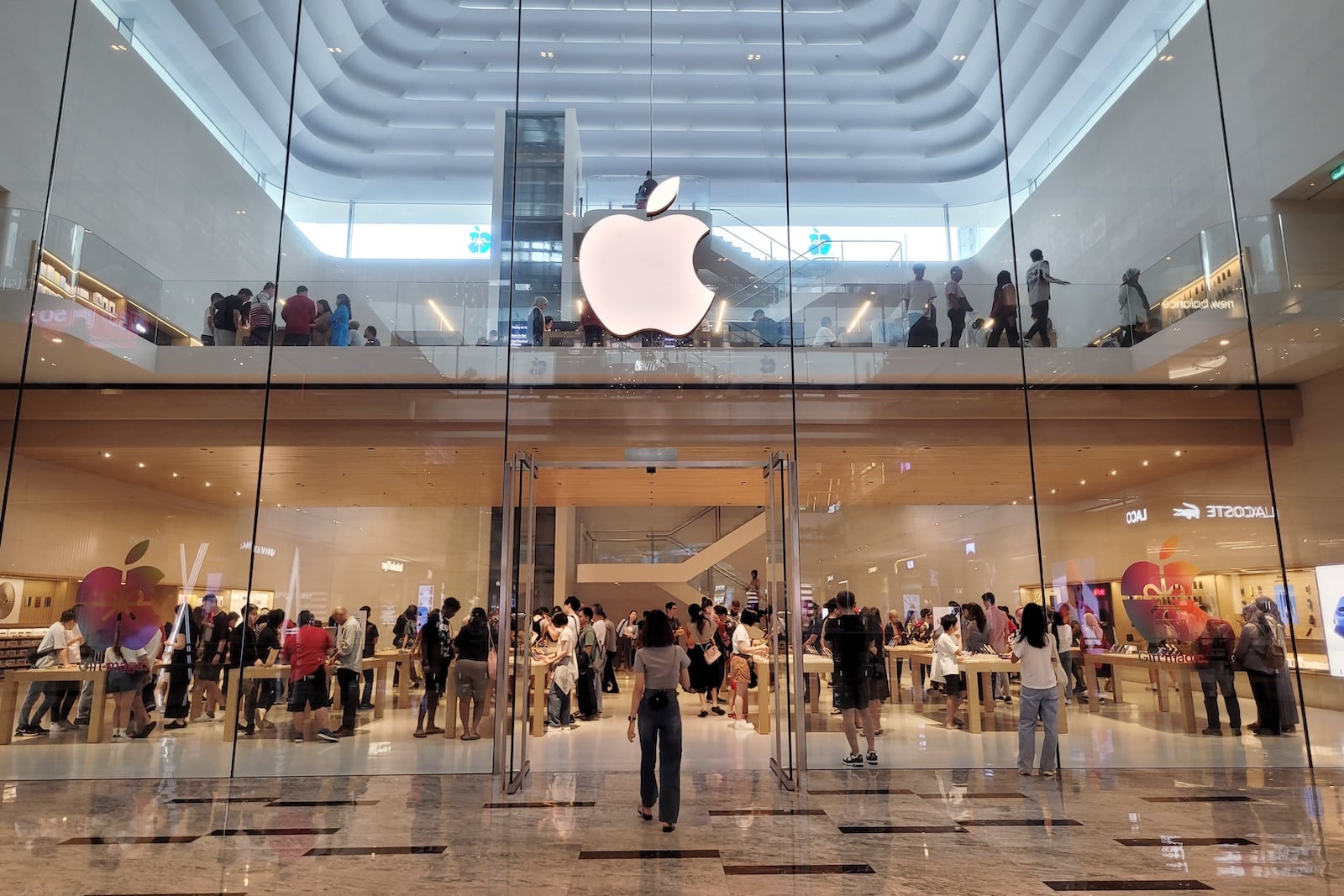
The stock market reacted immediately: In after-hours trading, the share price temporarily fell 6.5 to 8 percent below the closing price – after a quarter that brought record results in almost every sector. (Image: Shutterstock / TY Lim)
- Tim Cook's last conference call as Apple CEO
- Customs refunds boost Apple's margin
- Apple invests $11.73 billion in research – a new record
- Apple has 1.5 billion paid subscriptions
- Apple Q3 2026: $109.4 billion in the best June quarter
- Qualcomm loses Apple business faster than expected
- DOJ wants to overturn Apple's access to government records
- App Store: Apple fights back against London's regulatory plans