Cook steps down, Ternus takes over on September 1: Apple announces the biggest leadership change since 2011 – and defines an entire week in the process.
Some weeks are news weeks. This week was a watershed. With the official confirmation on Monday evening that John Ternus will succeed Tim Cook as Apple CEO on September 1, 2026, something fundamental has shifted for Apple, its observers, and its investors. Hardly an article went by that didn't refer back to this news in some way. Even topics like iOS 26.4.2, new AI models, or Apple TV strategy are suddenly viewed through the lens of the "Ternus era."
An overview of Apple Week from April 20th to 26th, 2026.
🔥 Story of the week: Tim Cook becomes Executive Chairman, John Ternus becomes new Apple CEO
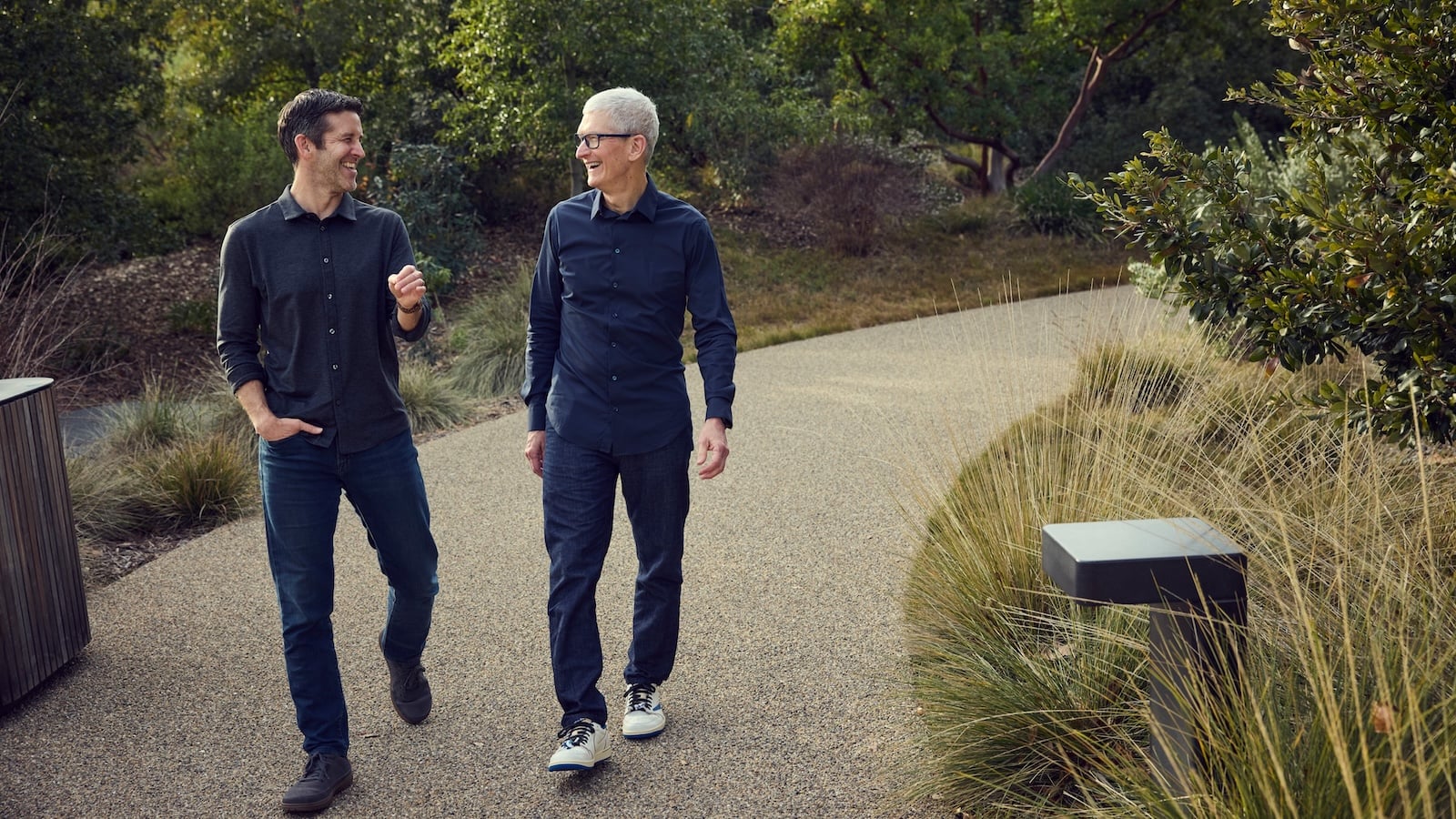
Apple officially announced on Monday, April 20, 2026, what had been anticipated for months: Tim Cook is stepping down as CEO after 15 years. His successor, effective September 1, 2026, will be John Ternus, currently Senior Vice President of Hardware Engineering. Cook will transition to the role of Executive Chairman of the Board of Directors, retaining a key, but non-operational, position focused on engaging with policymakers worldwide.
What's remarkable is the discipline with which Apple communicated the decision. According to SEC filings, the board of directors formally appointed Ternus as CEO as early as Friday, April 17. The information remained completely confidential for three full days – until the official press release on Monday evening. Even Bloomberg's Mark Gurman, Apple's number one chronicler, had described the Financial Times report about Cook's potential replacement at the end of 2025 as "simply wrong." The FT was right. Gurman was wrong for once, in a rare instance.
The day after the announcement, Cook and Ternus stood together on the stage of the Steve Jobs Theater before the entire Apple workforce. Cook directly addressed the rumors surrounding his health: He was healthy, had high energy, and planned to remain in his new role as Executive Chairman for "a long time." Ternus promised employees an "incredible roadmap" and called the moment the most exciting of his career at Apple.
Cook, in turn, set conditions for his departure: Apple's roadmap had to be "incredible," the finances had to be "great," and Ternus had to be ready for the role. With a market capitalization of over four trillion US dollars, annual revenue of 416 billion dollars, and a product pipeline including the iPhone Ultra, MacBook Ultra, and Apple Glasses, these three conditions have apparently been met from Cook's perspective.
Tuesday's town hall meeting also became a remarkable moment. Cook described the Apple Maps flop in 2012 as his "first big mistake" - a candid admission unusual from an Apple CEO. He considers the emotional high point of his tenure as CEO to be the Apple Watch, the first product developed entirely under his leadership.
Strategically, the choice of Ternus is a clear statement. Apple could have chosen a services manager, an AI specialist, or an external disruptor. Instead, the board of directors unanimously opted for a hardware engineer who has been with Apple for 25 years and whom Cook personally refers to as a mentor. This is no coincidence, but a conscious decision for continuity. Anyone hoping for radical reforms under Ternus - bringing back the headphone jack, ditching Liquid Glass, a new design direction - will be disappointed. Apple's planning horizon extends years into the future. The first products truly shaped by Ternus will likely not appear until 2028 or 2029 at the earliest.
The area where Ternus can make his mark will be particularly interesting. Reports from this week suggest that he is building a new internal AI platform within the hardware team, further integrating the interface between hardware and AI, and – according to a Deadline report – also positioning Apple TV more aggressively against Netflix and Disney+. Bloomberg describes his decision-making style as closer to Steve Jobs than to Cook: less deliberative, more decisive.
Another observation from the week: Wall Street reacted cautiously. Citi and Morgan Stanley confirmed their buy recommendations with price targets around $315. JPMorgan maintained its "overweight" rating on Apple with a $325 price target. Both major firms view the change as an orderly transition from a position of strength – not as a risk, but as a potential narrative reset.
This doesn't mean the Cook era is ending abruptly. Cook will remain CEO throughout the summer, leading Apple through WWDC on June 8 – his last major event in this role – and through the Q3 earnings report at the end of July. Ternus will officially take over on September 1. And Cook will remain involved as Executive Chairman. "This is not goodbye," he wrote in his public letter to the Apple community.
📰 What Else Mattered
iOS 26.4.2 is here – with an FBI-relevant security patch
Apple released iOS 26.4.2 on Wednesday. The update is small but security-relevant: it closes a vulnerability that, according to previous reports, the FBI could exploit to recover deleted Signal messages from iPhones. Besides the security patches, the update includes bug fixes but no visible new features. Apple is now focusing on the final release of iOS 26.5 and preparing for iOS 27, which will be unveiled at WWDC in June.
Ternus is building a new AI platform within its hardware team
The designated CEO is already making his mark even before officially taking office. According to reports this week, Ternus is establishing a new internal AI platform within hardware development. The goal: to better integrate the interface between hardware and artificial intelligence – in line with Apple's privacy philosophy, which aims to keep as much AI processing as possible local on the device. Apple's investments in Neural Engines have been pointing in this direction for years. Under Ternus, this focus is likely to intensify.
iOS 27 and macOS 27 bring stricter Network Security
Apple released an official support document this week titled "Prepare your network environment for stricter security requirements." The document states that starting with iOS 27, iPadOS 27, macOS 27, watchOS 27, tvOS 27, and visionOS 27, Apple systems may refuse connections to servers with outdated or non-compliant TLS configurations. Apple has not yet specified concrete TLS versions or cipher requirements, only mentioning that "additional security requirements" will apply. The document is primarily aimed at IT administrators and MDM developers. Private users do not currently need to take any action, but could be indirectly affected if companies or third-party providers do not adapt their backends in time. Apple's decision to communicate this information now - five months before the iOS 27 release - gives server operators sufficient time to adjust.
OpenAI releases GPT-5.5
Seven weeks after GPT-5.4 Thinking, OpenAI is releasing its next major update, GPT-5.5. The model is available in ChatGPT and Codex for Plus, Pro, Business, and Enterprise users. The focus is clearly on agent-based tasks: GPT-5.5 is designed to autonomously plan and test code, operate web apps, and perform multi-stage searches. For developers, this means more possibilities - but also higher costs. This is relevant for the Apple ecosystem because OpenAI models are integrated into Siri and are slated for further enhancement in iOS 27.
Perplexity CEO: AI will make the iPhone more important, not obsolete
Aravind Srinivas, CEO of Perplexity, put forward a remarkable thesis this week: AI won't make the iPhone obsolete, but rather more valuable. With over two billion active devices worldwide, Apple sits on the most attractive data foundation in the industry. The crucial question is: Will Apple, under Ternus's leadership, capitalize on this? This very intersection between hardware reach and AI potential will be one of the key battlegrounds of the coming years.
💡 Rumor of the Week
Memory chip shortage delays MacBook Ultra and Mac Studio
Mark Gurman reported in his Power-On newsletter that the global memory chip shortage is disrupting Apple's roadmap. The new Mac Studio, previously expected in mid-2026, is now likely to ship no earlier than October. The launch of the MacBook with the M6 chip and touchscreen – possibly under the MacBook Ultra brand – is being pushed back from late 2026 to early 2027. Both products were considered key components of this year's Mac strategy.
This is a noticeable drag on Apple's hardware pipeline. RAM prices are rising worldwide because hyperscalers like Google, Microsoft, OpenAI, and Anthropic are massively buying up memory for their AI data centers. Apple is a major consumer due to its volume, but even Apple cannot escape this market pressure. Tim Cook had already indicated in a previous earnings call that the supply chain was "less flexible" than usual.
It will be interesting to see what this means for the WWDC keynote on June 8th. Without a new Mac Studio, a key hardware story is missing. It's possible that Apple will only announce the Studio there, with delivery following later – similar to what happened with the Vision Pro.
📊 Number of the week
1,000 percent. That's how much Apple's market capitalization has grown under Tim Cook's leadership – from around $350 billion in August 2011 to over $4 trillion today. Annual revenue has almost quadrupled in the same period: from $108 billion in fiscal year 2011 to over $416 billion in fiscal year 2025. Ternus is therefore not acquiring a turnaround project, but the most valuable company in the world – with a cash flow that most corporations can only dream of. In fiscal year 2025 alone, Apple returned $90.7 billion to shareholders through share buybacks – more than the annual revenue of almost all DAX-listed companies combined.
👎 Flop of the Week
"My first big mistake": Cook on Apple Maps
At an internal town hall meeting on Tuesday, Cook spoke surprisingly candidly about the biggest failures of his time as CEO – describing the Apple Maps debacle in 2012 as his "first big mistake." The app, shortly after its launch with the iPhone 5, was criticized worldwide for serious accuracy issues. Cook issued a public apology, Scott Forstall lost his job, and Eddy Cue took over Apple Maps.
What's remarkable is the self-reflection. CEOs don't usually speak publicly about their own mistakes, especially not from a CEO known for his communication discipline. The fact that Cook specifically mentions Apple Maps and not, say, the Vision Pro or the discontinued Apple Car has its own logic: chronologically, Maps was the first major reputational blunder of his tenure – and simultaneously a product that Apple subsequently stabilized with considerable effort. Today, Apple Maps is one of the most reliable mapping products on the market – the recovery began with a public admission.
🔭 What's Coming Next Week
- Thursday, April 30: Apple Q2 2026 earnings call. Cook's penultimate earnings call as CEO. Analysts expect solid growth, driven primarily by iPhone and services. It will be interesting to see if Cook makes any concrete statements about performance in China and the Siri release date.
- iOS 26.5 is nearing its final release. Apple is expected to release the final version within the next two to three weeks.
- WWDC preview article on apfelpatient.de. Our comprehensive preview of the Apple developer event from June 8th to 12th will follow in early May – focusing on iOS 27, the new Siri, and potential hardware announcements.
💬 My opinion: Ternus instead of an AI man is a deliberate statement
Apple had a choice. The board could have chosen a services manager, a classic operations expert like Cook, or an external AI specialist to finally fix the Siri debacle. Instead, the board unanimously opted for a hardware engineer who has been with Apple for 25 years and whose views on X are uncontroversial.
This is no coincidence – it's a message. Anyone who prioritizes hardware excellence over software speed, who values long-term platform strategy over short-term AI races, who values stability over disruption, chooses an engineer. Apple's board of directors has thus confirmed a thesis that has defined the company for years: The platform beats the model. The iPhone beats the chatbot. The Neural Engine beats cloud LLM.
This thesis is risky. If the new Siri expected at WWDC fails to impress, if ChatGPT, Claude, and Gemini continue to draw iOS users away from the Apple ecosystem, if the AI competition pushes Apple ahead, then Ternus's approach will quickly be called into question. But if Apple manages to integrate AI where it truly delivers added value - seamlessly, locally, with privacy in mind, and hardware-based - then the board has chosen the right person in Ternus.
The next 18 to 24 months will be decisive. At the latest with iOS 27 this fall, the Apple Glasses in 2027, and the first complete product launch under Ternus' sole responsibility, it will become clear whether this thesis holds true. I am cautiously optimistic – for three reasons: First, Apple has an exceptional hardware foundation that no one else in the industry can replicate. Second, Cook remains present as Executive Chairman, providing a corrective influence. Third, Ternus' decision-making style – according to Bloomberg, faster, clearer, and less deliberate than Cook's – could restore to Apple precisely the operational speed that is needed in the AI era.
It was time for a change. And it was right to do it the way Apple did: in an orderly fashion, kept secret, and from a position of strength. This is Cook's last major contribution as CEO. The rest belongs to Ternus.
Apfelpatient Weekly #3 – the week at a glance
One week, one headline. The CEO change from Cook to Ternus is Apple's biggest personnel decision since 2011 – and it overshadows everything else. But the week also had other substance: a major security patch in iOS 26.4.2, new strategic signals for the Ternus era, an OpenAI update with implications for Apple's AI strategy, and a memory bottleneck that is disrupting the Mac roadmap.
Next week we'll be looking at Apple's Q2 2026 earnings – Cook's penultimate quarter as CEO. Until then: Happy reading and have a great start to the week from Apfelpatient.
The best products for you: Our Amazon Storefront offers a wide selection of accessories, including for HomeKit. (Image: Apple)
📚 From Our Archive
Anyone who wants to delve even deeper into the two main characters of the week can find the whole story in these two profiles:
- Tim Cook: Biography, career path & his time as Apple CEO – from newspaper delivery boy in Alabama to the most powerful CEO in the tech industry
- John Ternus: Biography, career & the new Apple CEO – how a mechanical engineering student and competitive swimmer became the man to whom Cook entrusted Apple