Apple is repeatedly clashing with regulators worldwide over whether the company should be allowed to charge fees for access to key iPhone features and platforms. The latest point of contention has emerged in Brazil: the iPhone's NFC payment function. Banks and payment providers there are demanding that access be made free. Apple is resisting, calling it an attempt to share proprietary technology for free.
The discussion is not new in Brazil. The Council for Economic Protection (CADE) has already pursued action against Apple for antitrust allegations surrounding the App Store. This led to measures in Brazil, including the introduction of alternative app stores and external payment methods. Now the focus is shifting: the App Store is no longer the central issue, but rather Apple's rules for NFC payments on the iPhone.
This time it's about: NFC payments on the iPhone
The trigger was a report by O Globo, which was later picked up by 9to5Mac. In it, Apple describes how third parties, such as banks and payment service providers, want "free" access to Apple's proprietary technologies. This refers to the NFC payment platform that enables the iPhone to make contactless payments.
The background: In Brazil, the market is currently moving towards NFC. Services like Pix want to move away from purely QR code payments and rely more heavily on NFC. This is already easier on Android because Google has approved the technology for Android smartphones. This approach has not yet gained the same traction on the iPhone.
Why Pix and banks are putting on the pressure
The central issue is Apple's fee model: Apple charges payment processors and banks a fee for each transaction if they want access to iPhone NFC functionality. CADE and several banks criticize this as potentially anti-competitive.
From their perspective, it appears that Apple is controlling a key technology and making its use more expensive for competitors. This is particularly relevant for Pix, because while the service wants to switch to NFC, it doesn't want to pay for access.
Apple's response: a familiar argument, this time with a focus on Brazil
Apple counters with an argument familiar from similar debates, but at least it is structured in a comprehensible way:
- Apple Pay is not only more secure, but also more convenient.
- Apple also emphasizes that Apple Pay was already launched in Brazil in 2018 and was supported by more than 40 banks and issuers at that time.
This demonstrates that it has long been possible to build a broad Apple Pay offering in Brazil, and that many market participants have already embraced it.
The catch: iPhone market share is only around 10 percent
At the same time, the situation in Brazil is unique: According to the report, the iPhone only has about 10 percent market share there. Apple Pay, even with its good technical integration, is therefore more of a minority platform.
Apple uses precisely this point in its defense. If the iPhone only represents a relatively small portion of the market, this is supposed to argue against the classification of Apple Pay or NFC fees as anti-competitive. In short: too little market power to distort competition on a large scale.
Apple criticizes Pix as "inferior" and warns of friction
Apple isn't just focusing on market share; it's also attacking Pix on quality. The core argument is that an NFC access model desired by banks could generate more friction than Apple Pay and Apple Wallet.
Apple explains that with such a model, users wouldn't be able to simply switch between different payment cards within a central wallet, but might have to select a different payment solution each time. This could reduce the willingness to switch between cards easily.
It's no longer about "being allowed to", but about "paying"
The question is no longer whether Pix is fundamentally allowed to use iPhone NFC technology. Apple introduced a feature in iOS 18 that allows third-party developers access to this technology.
The dispute therefore revolves primarily around price: Pix wants access without paying for it. Apple insists that access to its platform and ecosystem should be compensated.
Cade must decide
How CADE will ultimately decide remains to be seen. The report also suggests that Apple has won similar disputes concerning the App Store and other services in the past. Regulators have repeatedly acknowledged that Apple is generally entitled to charge for access to its ecosystem.
Whether this logic also applies to NFC in Brazil is exactly what is now being examined.
Apple and Brazilian banks are in dispute over NFC fees
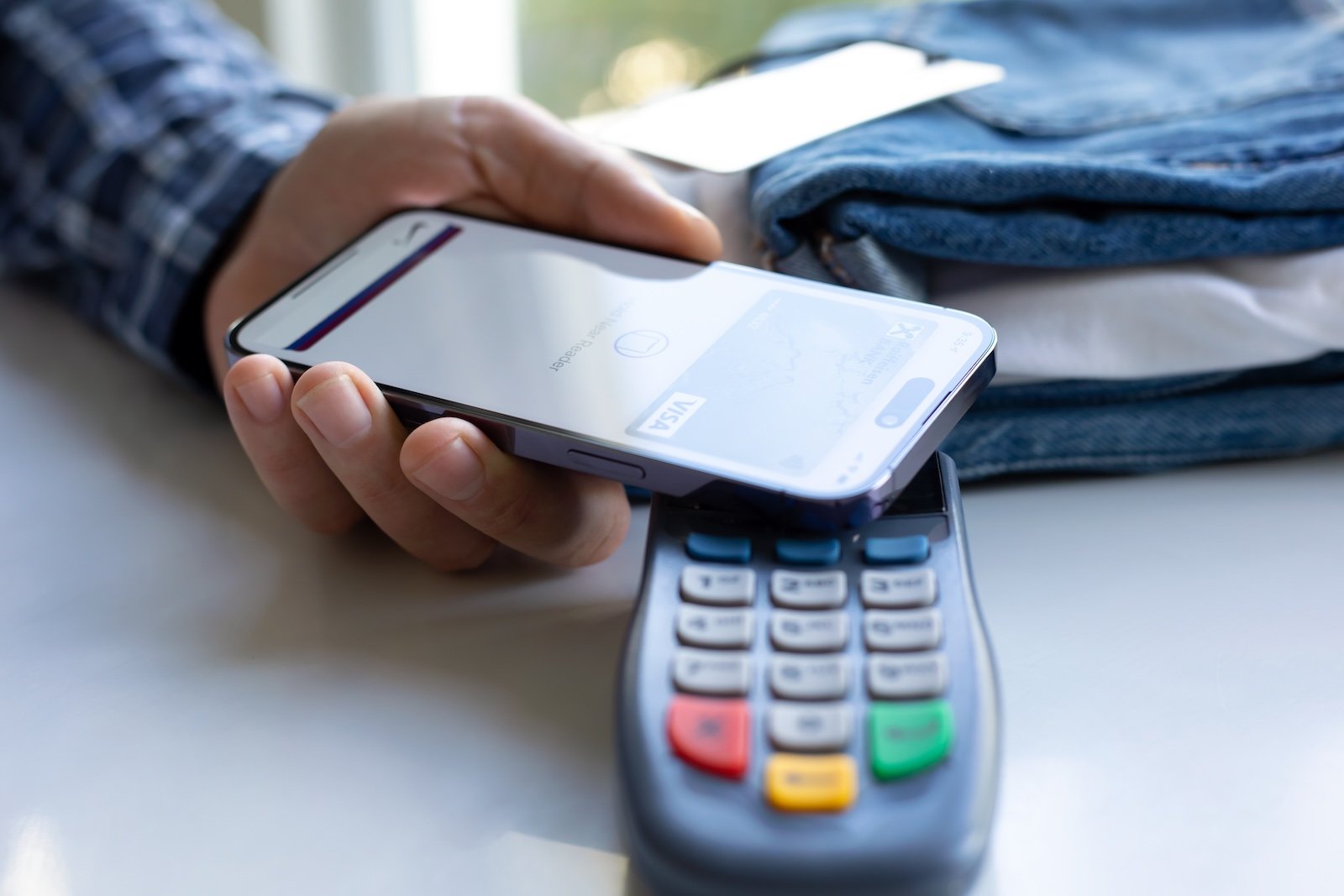
In Brazil, two opposing positions are clashing: Banks and payment service providers want to use NFC payments on the iPhone, but without paying transaction fees to Apple. Apple counters, citing security, convenience, the early launch of Apple Pay with broad bank support since 2018, and the fact that the iPhone only holds about 10 percent market share in the country. Furthermore, with iOS 18, technical access for third-party providers is fundamentally possible; the conflict now clearly centers on whether Apple is allowed to charge for this access. How CADE assesses NFC access remains to be seen. (Image: Shutterstock / DenPhotos)
- Avalanche disaster: iPhone becomes a lifesaver
- Apple vs. Jon Prosser: Trial gains momentum
- Apple case designed to connect iPhone to satellites
- Apple and CSAM: Lawsuit raises serious allegations
- WhatsApp adds an important feature to groups
- Apple C1X modem: First failure raises questions
- Apple TV adds "The Hunt" to its March lineup
- Lawsuit against Meta: Apple becomes part of the debate
- iOS 26.4 opens CarPlay for ChatGPT & Co.
- iOS 26.4: This is what the new CarPlay streaming looks like
- Data leak: 1 billion data records exposed online
- Perplexity says goodbye to advertising
- Apple Music Connect becomes a promo hub
- iOS 26.4: These changes are barely noticeable
- iOS 26.4: New sleep metrics and vital data
- tvOS 26.4 removes iTunes apps from Apple TV
- Anthropic releases Claude Sonnet 4.6 update
- Apple upgrades Private Cloud Compute with M5
- iOS 26.4 makes Hotspot data usage visible
- Apple stock: Wedbush remains calm despite Siri
- iOS 26.4 Beta reveals traces of Apple Health+
- iOS 26.4: Code indicates Apple TV in CarPlay
- iOS 26.4: All new features of Beta 1