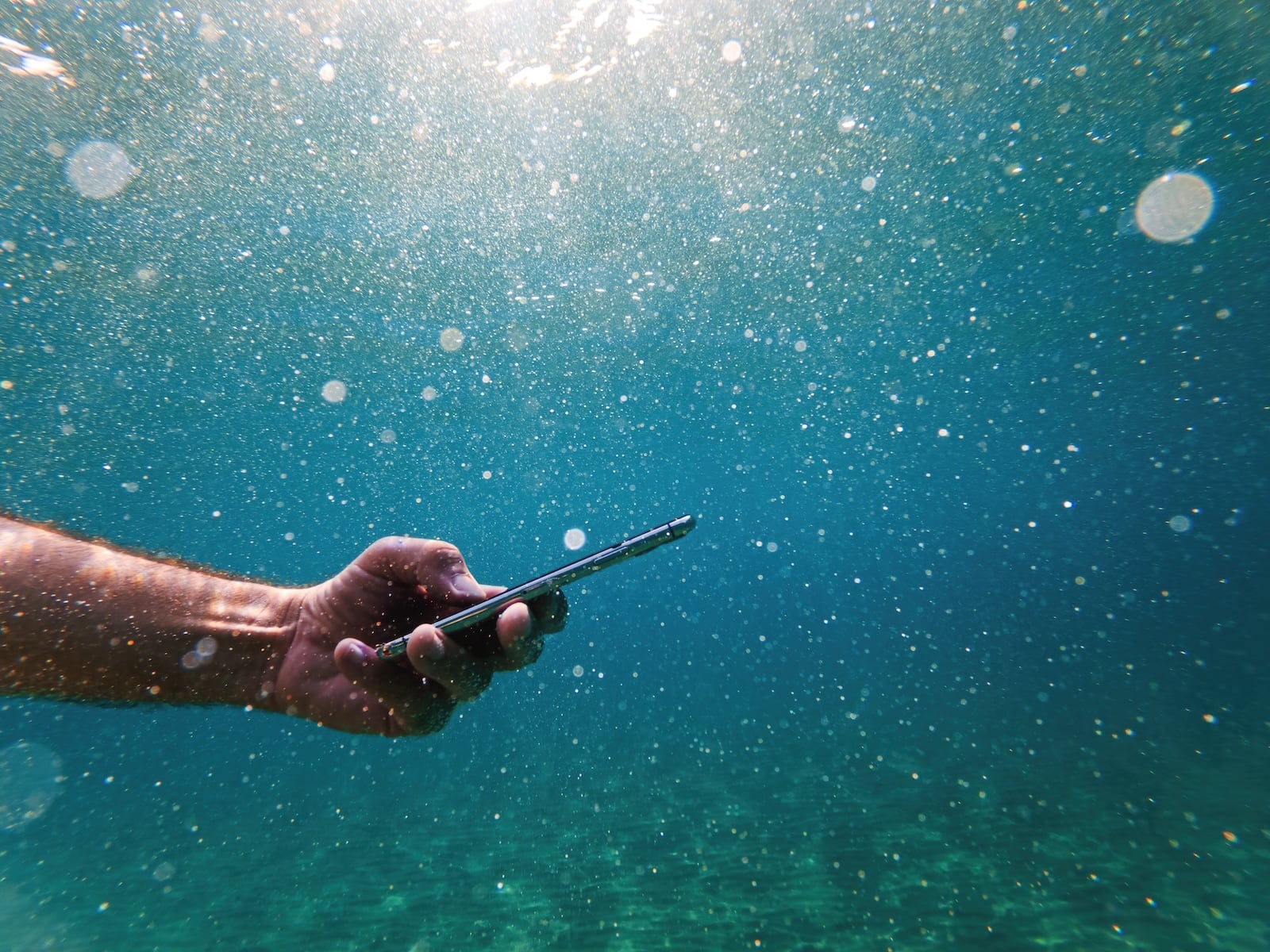
Apple isn't just thinking about improving the iPhone's water resistance, but also about professional underwater photography. A newly granted patent reveals an unusually compact approach that could replace the classic dome ports found on professional equipment – possibly as an accessory integrated into an iPhone case.
Apple's list of ongoing research projects is long, and the US Patent and Trademark Office regularly provides new insights into these technologically exciting projects, which are not yet commercially viable. The latest patent grant concerns a very specific idea: How could an iPhone take underwater photos without a physical barrier ruining the image quality? While Apple has previously filed patents related to significantly improving the iPhone's water resistance, this new initiative goes a crucial step further – toward images that scuba photographers have previously only been able to achieve with expensive professional equipment.
The problem with classic underwater photography
In the patent application entitled "Plurality of Optical Centers in a Unified Free Form, Hemispherical Optic," Apple first describes the fundamental problem. In classic underwater photography, the camera system must be protected. This is usually achieved with a separate barrier in front of the lens, such as a so-called dome port – the dome-shaped glass hood that is standard in underwater photography.
This solution, however, is a balancing act. While a dome port corrects some of the distortion caused by immersion in water, it can also introduce new distortions. Furthermore, traditional dome ports are bulky and generally too large to fit into a practical smartphone setup. Apple's patent aims to change precisely that.
A single lens instead of many domes
The core of the patent is a single, continuous protective optic that covers multiple cameras simultaneously. Instead of constructing a separate dome for each camera, a single shaped layer would lie over all lenses at once. This layer would simultaneously serve as a protective barrier and a lens element, becoming part of the optical design of each camera module.
Apple's patent illustrates two variations of this solution. If the camera lenses are arranged on a flat surface, the central optics could also be kept essentially flat – with slight bulges over the lenses. With a curved camera arrangement, the protective optics would follow the respective curvature. Each individual bulge in the optical component would correspond exactly to the curvature of the underlying lens.
Why one-piece construction is crucial
The decisive advantage lies in the manufacturing process. The protective optics are to be produced as a single element – without seams, adhesives, or other connecting materials. This design has two direct consequences: First, it eliminates the space required for connection points between separate dome elements. Second, potential points of water ingress disappear, as there are no dividing lines where leaks could form.
This also has an optical effect. Seams or glued joints can themselves cause distortions because light is refracted differently at these transitions. A continuous lens made from a single material completely avoids this problem. Apple is thus directly addressing the common weakness of existing underwater solutions.
More of an accessory than a standard feature
Six pages of schematic drawings and four pages of detailed text suggest a sophisticated technical approach. Nevertheless, the solution is unlikely to be integrated directly into every future iPhone. Apple itself suggests the possibility that the system could be incorporated into an iPhone case – as a special accessory for users who regularly want to take underwater photos.
This division would reflect Apple's usual line between standard iPhones and specialized models. A full-fledged diving setup for every model would be too bulky and unnecessary for most users. A slim design in a separately sold case, on the other hand, could be clearly positioned as an optional professional feature.
Where Apple's camera research otherwise stands
The patent application fits into a broader camera research project that Apple is currently pursuing in several directions. Some time ago, it was reported that the iPhone Ultra would feature a 24-megapixel camera under the display – an area the industry has been working on for years. At the same time, Apple is apparently also working on an iPhone made from a single piece of glass. The recent underwater lens fits this line of thought: fewer visible components, more functional integration into a single element.
The patent names two inventors: Ryan M. Sheridan and Benjamin D. Buckner. Buckner had previously worked at Apple on a patent dealing with the typical fisheye distortion caused by certain lenses – a clear thematic precursor to his current work on underwater photography without optical distortion.
From patent to product is a long way
As is always the case with Apple patents: A grant from the US Patent and Trademark Office says nothing about whether the technology will ever make it into a finished product. Apple routinely files hundreds of patents, a significant number of which simply serve to protect its own research approaches.
Nevertheless, the level of detail in the current document demonstrates how seriously Apple is taking the issue. Should a slim underwater case actually appear one day, it would likely represent a significantly more practical setup for Apple users than any existing third-party solutions. Until then, it remains a technologically ambitious idea in the patent database – with an unusually concrete approach to a solution.
Today's solutions for underwater photography
For those who don't want to wait years for a potential Apple solution, third-party manufacturers already offer sophisticated options. Classics in the high-end segment include the waterproof cases from SeaLife SportDiver or AquaTech AxisGo, which protect the iPhone at depths of 10 to 40 meters and feature dedicated controls for underwater use. For occasional snorkeling sessions or poolside photos, more affordable solutions like the Catalyst Total Waterproof Case series or the Ghostek Nautical series, which combine solid water protection with everyday usability, are often sufficient.
Important for all versions: Check compatibility with your specific iPhone model beforehand, as camera layouts vary with each generation. (Image: Shutterstock / Bits And Splits)
- Apple Patent: Vision Pro could become modular and upgradeable
- Apple is working on an Apple Pencil with realistic haptics
- Apple case designed to connect iPhone to satellites
- Apple is bringing Touch ID back under the Display
- Apple Vision Pro: Will there be an Apple Pencil-like controller?
- Apple reported significantly fewer patents in the US in 2025
- AirPods of the future: Apple is researching smart gesture logic
- Apple plans fabric displays for HomePod and other devices
- Apple wins long-running dispute over iPhone camera patents
- Apple develops magnetic game controller for iPhone & iPad
- Apple relies on smart mattress sensors for sleep tracking
- Apple develops next-generation Taptic Engine
- Apple Ring – new patents give hope for an innovative wearable
- Apple Vision Pro could get more touch controls
- Apple files patent for iPhone made from a single piece of glass
- Apple is working on light signals for Apple Ring and more
- Apple files patent for new mouse button in keyboard
- Will Apple Pencil soon be available as a stylus for all Apple devices?
- Apple patent proves: AirPods with cameras in development
- Apple could improve Vision Pro for travel via software
- AirPods learn to read lips: Apple plans silent control