
Apple is poised for a comprehensive overhaul of Apple Intelligence and Siri in 2026. The introduction of "Playlist Playground" in iOS 26.4 demonstrates once again how Apple understands and utilizes artificial intelligence. AI is not presented as a dominant flagship feature, but rather as a supporting tool in the background. This approach is consistent with the company's existing strategy: Apple integrates AI in a controlled, optional, and functional manner. "Playlist Playground" serves as a current example of this overarching approach.
If Apple's development over the past few years has been closely followed, its stance on artificial intelligence has always been clear. Apple does not use AI to replace human labor, but rather to complement it. It is intended to support workflows, not replace them.
System-wide access to controls via app intents and the more personalized Siri can be significant or barely noticeable, depending on individual workflows. This flexibility is part of the strategy. Apple doesn't view AI as a world-changing paradigm that needs to completely redefine every product.
Even as AI becomes increasingly prevalent in the Apple ecosystem, it remains optional. Those who don't actively use it can largely ignore it.
Playlist Playground in iOS 26.4
iOS 26.4 introduced a new AI feature called "Playlist Playground" to assist with creating playlists in Apple Music. It is not a music generation system. The feature does not replace human curation and does not produce new songs.
Instead, it expands existing functions. It helps to compile playlists more efficiently. Especially in combination with Siri, this support can remain almost invisible. It's possible that AI works in the background without being consciously noticed.
This feature is clearly related to Beats Music's "The Sentence", which was already based on machine learning. At a different stage of product development, Apple might not have labeled this feature as AI, but simply introduced it as a new convenience feature within Apple Music.
AI playgrounds as a marketing tool
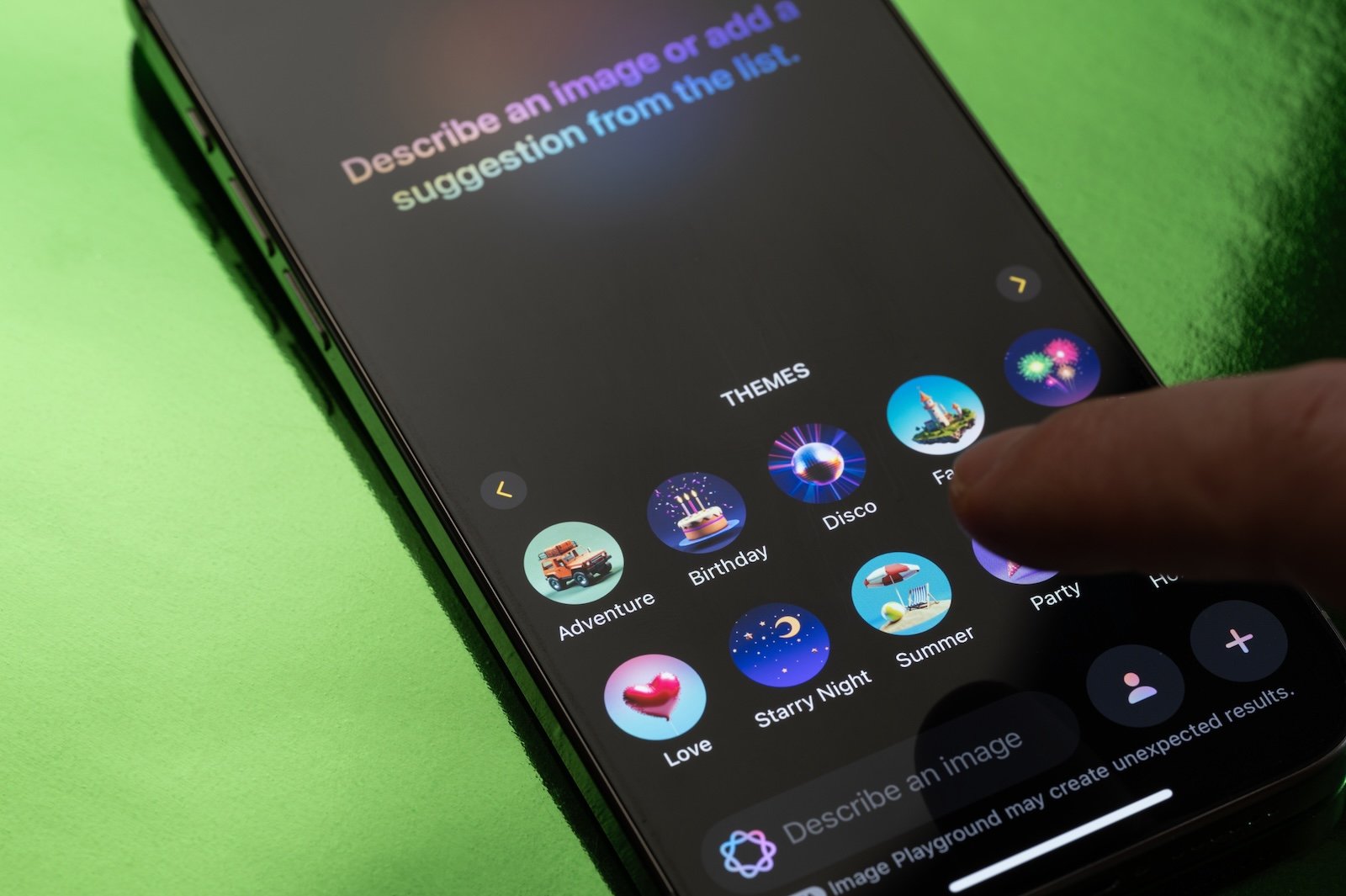
Apple currently integrates generative AI exclusively within larger creative tools. Image Playground is part of the Notes and Presentation features. Writing Tools are integrated into document creation.
There is currently no standalone Apple feature that aggressively advertises the promise of creating art or content from scratch. Even the AI tools in Logic are designed as add-on features.
Image Playground also frequently delivers results that appear more playful than professionally usable. This creates the impression of an experiment or a toy, rather than a central creative interface.
A similar picture emerges in the field of software development. Xcode itself does not include native generative code tools. However, Apple allows the integration of external models that can generate code from text commands. If this external approach is chosen, it is available.
However, it's important to note that this pure code generation is not part of Apple Intelligence. Apple deliberately separates its own AI integration from external generative solutions.
Limited generativity and conscious control
Apple limits generative AI capabilities through low usage tokens. Computing power on servers incurs costs, and Apple controls the intensity of its use.
It is possible to use existing AI tools in a fully generative mode. In practice, however, they are often inefficient and of lower quality in this mode compared to specialized competitor offerings outside the Apple ecosystem.
This doesn't mean Apple rejects generative AI. Rather, it deliberately avoids positioning it as its primary use case. For purely generative tasks, more powerful solutions often exist outside the Apple ecosystem.
Playlist Playground is consistent here as well. It doesn't generate music and doesn't replace any creative decision-making. It simply expands an existing range of functions.
Ethics, data protection and long-term orientation
Apple's fundamental AI strategy appears to be based on ethical principles. AI should complement humans, not replace them. This approach has been repeatedly emphasized by Apple executives.
The idea is that AI works in the background and is barely noticeable in daily use. Combined with Apple's focus on data privacy and security, this results in a long-term positioning strategy.
Whether users actively evaluate this ethical approach is an open question. The fact remains that Apple continues to achieve record financial results, even without making AI its dominant selling point.
The timing for the relaunch of Apple Intelligence
The introduction of the new playlist feature can be seen as a glimpse into Apple's upcoming intelligence pipeline. Previous reports suggested that iOS 26.4 could serve as the starting point for new AI initiatives.
This assumption was tied to a spring release. iOS 26.4 appears to be heading towards a March release date. Since Apple often defines "spring" as late March or April, iOS 26.5 could ultimately be the actual launch date for the revamped Apple Intelligence and Siri.
Additionally, a media event has been announced for March 4th, where the iPhone 17e and a brand-new entry-level MacBook are expected to be unveiled. This event could also serve as a platform for the presentation of new Apple Foundation models trained by Google Gemini.
Whether the new features will appear as a late beta update for iOS 26.4 or be officially included in iOS 26.5 is currently unclear. However, there are no indications of major delays. The communicated timeframe of "coming in 2026" still seems realistic.
Apple focuses on integration rather than staging when it comes to AI
Apple's "Playgrounds" approach highlights a clear strategy. AI is not used as a revolutionary guiding principle, but rather as a supporting tool in the background. Playlist Playground in iOS 26.4 confirms this approach.
Apple integrates artificial intelligence in a controlled, optional, and functional way. Generative capabilities exist but are not the focus. The planned overhaul of Apple Intelligence and Siri in 2026 is likely to further solidify this approach.
Apple focuses on integration rather than staging. This is precisely where the company's strategic consistency lies. The best products for you: Our Amazon storefront offers a wide selection of accessories, including those for HomeKit. (Image: Shutterstock / PixieMe)
- Apple Experience on March 4th: Possible Highlights
- OLED iPad mini: Is a major upgrade coming?
- AirPods Pro 3: Second version expected to bring new AI features
- Apple 2026: These Home devices are planned
- Mac Studio 2026: What's in the next update
- iPhone 18 Pro: Why the C2 modem is becoming important
- MacBook Pro 2026: Why waiting is worthwhile
- MacBook Air with M5: All the details about the upcoming update
- New MacBook planned: Affordable entry-level model with A18 Pro
- Apple TV makes Silo bigger: All the info on season 3
- Apple plans to launch two new products for the mass market in 2026
- Apple TV: The February 2026 Highlights at a Glance
- Apple in February 2026: iOS 26.3, Siri and important dates
- iPhone 18 Pro: All the leaks, technology, and reasons to wait
- iPhone: iOS 26.3 reveals Apple's modem strategy
- AirTag 2 vs. AirTag: All new features & differences at a glance
- AirTag 2: Meaningful improvements without a complete overhaul
- AirTag 2: All the improvements in tracking and technology
- Apple plans to use Siri as an AI chatbot: All the details on iOS 27
- iPhone 2026: All new models and Apple's big plans
- Apple has big plans for AI's future: Siri 2.0 is just the beginning
- Apple 2026: These five new products are in focus
- Apple Creator Studio or Adobe Creative Cloud Pro?