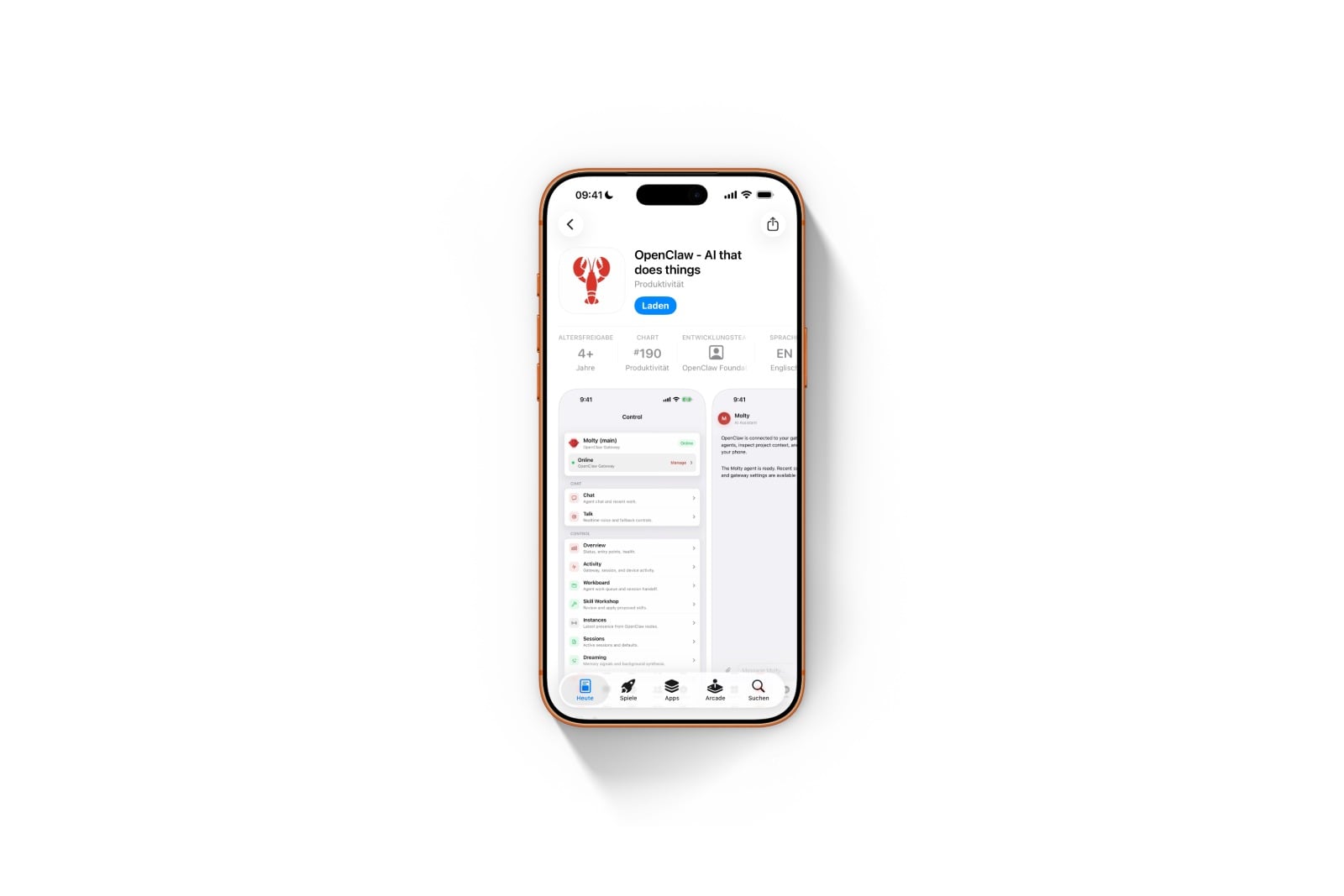
OpenClaw, the AI agent that recently garnered attention as a viral open-source project, has released its first official app for the iPhone. It transforms the smartphone into a central hub of the system, offering chat, voice control, and access to numerous device functions. The app is available now for free on iPhone, iPad, and Apple Watch.
OpenClaw isn't a typical chatbot, but rather an AI agent: software that not only answers queries but also independently performs tasks – from sorting emails and scheduling appointments to triggering entire workflows. Previously, the system was primarily controlled via messengers like WhatsApp or Telegram and the command line. The new app introduces native control for iPhone and iPad, integrating the device as a secure node into your OpenClaw setup. Since the app can access personal data extensively, controlling this access is crucial – on iPhones, the app privacy report in the settings allows you to track which app accessed your camera, location, or contacts and when.
From hobby project to viral AI agent
OpenClaw, created by Austrian developer Peter Steinberger, was initially released in late 2025 under the name Clawdbot – a reference to Anthropic's AI Claude, which was changed after a trademark complaint. Within a few weeks, the open-source project garnered over 100,000 stars on GitHub, making it one of the fastest-growing open-source projects ever.
What makes OpenClaw special is its local approach: The system runs on its own hardware, stores its data as simple files, and optionally uses cloud models from Anthropic, OpenAI, or Google, or locally operated models. At the beginning of 2026, Steinberger moved to OpenAI; the project itself was transferred to an independent open-source foundation supported by OpenAI.
What the iPhone app can do
The app connects the iPhone to the private OpenClaw gateway, the central instance operated by the user, via QR code or setup code. Several functions are then available:
- Chat with your personal assistant directly from your iPhone
- a real-time and background voice mode
- Checking and confirming action releases of the gateway
- Sharing text, links, and media from iOS to OpenClaw
- selectively enabling individual device functions such as camera, screen, location, photos, contacts, calendar and reminders
- Push notifications and status updates for ongoing workflows
The app is available for free in the App Store and supports iPhone, iPad and Apple Watch.
Local control as a principle – and its downside
OpenClaw prioritizes the principle of data sovereignty: the gateway, keys, configuration, and permissions reside with the user; device access is controlled exclusively via iOS permissions and can be restricted to the desired functions. This very absence of a third-party cloud service is considered a key advantage over traditional assistants.
At the same time, OpenClaw has faced criticism since its rise. Security researchers point to the extensive access rights such an agent requires and to risks such as the injection of malicious instructions via manipulated content. While its local architecture keeps data away from external servers, it shifts the responsibility for secure configuration more heavily onto users than with a closed-source service.
Autonomous AI agents reach the iPhone
With its own app, a technology previously reserved primarily for developers and experienced users is moving closer to everyday life. Agent-based AI, which not only responds but also acts, is becoming more mobile – and potentially accesses a large portion of personal data via the iPhone. How much users trust this software and what access they grant remains a conscious decision. (Image: Apfelpatient)
- iPhone 18 Pro drop tests surface on the dark web
- iOS 26.5.2, iPadOS 26.5.2 and macOS 26.5.2 are here
- iOS 26.6 Beta 3: Apple nears completion
- WhatsApp: Usernames can now be reserved
- Apple acquires the award-winning design tool Play
- Indian antitrust case: Apple accuses the authority of plagiarism
- Apple and Chinese storage: Approval is likely to be difficult
- Apple is seeking approval for Chinese storage devices
- The US partially releases Claude Mythos 5
- Data leak at Tata: Apple and suppliers react
- OpenAI poachs Apple's Vision Pro and glasses chief
- Storage crisis: Apple is also said to be partly responsible
- Apple is heading towards record market shares in 2026
- Apple hints at further price increases
- Apple is raising prices: Macs, iPads and more are getting more expensive
- Siri AI should clearly reject URL summaries
- Stolen iPhone: Apple tightens its recommendations