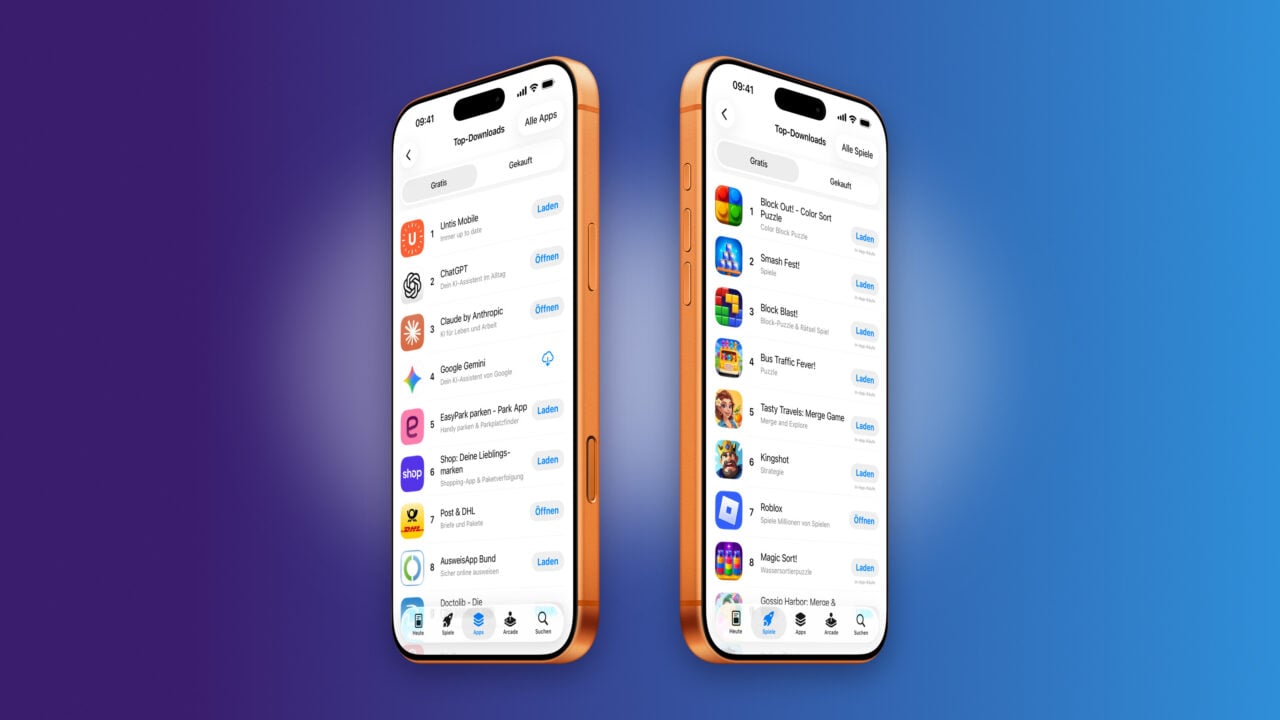
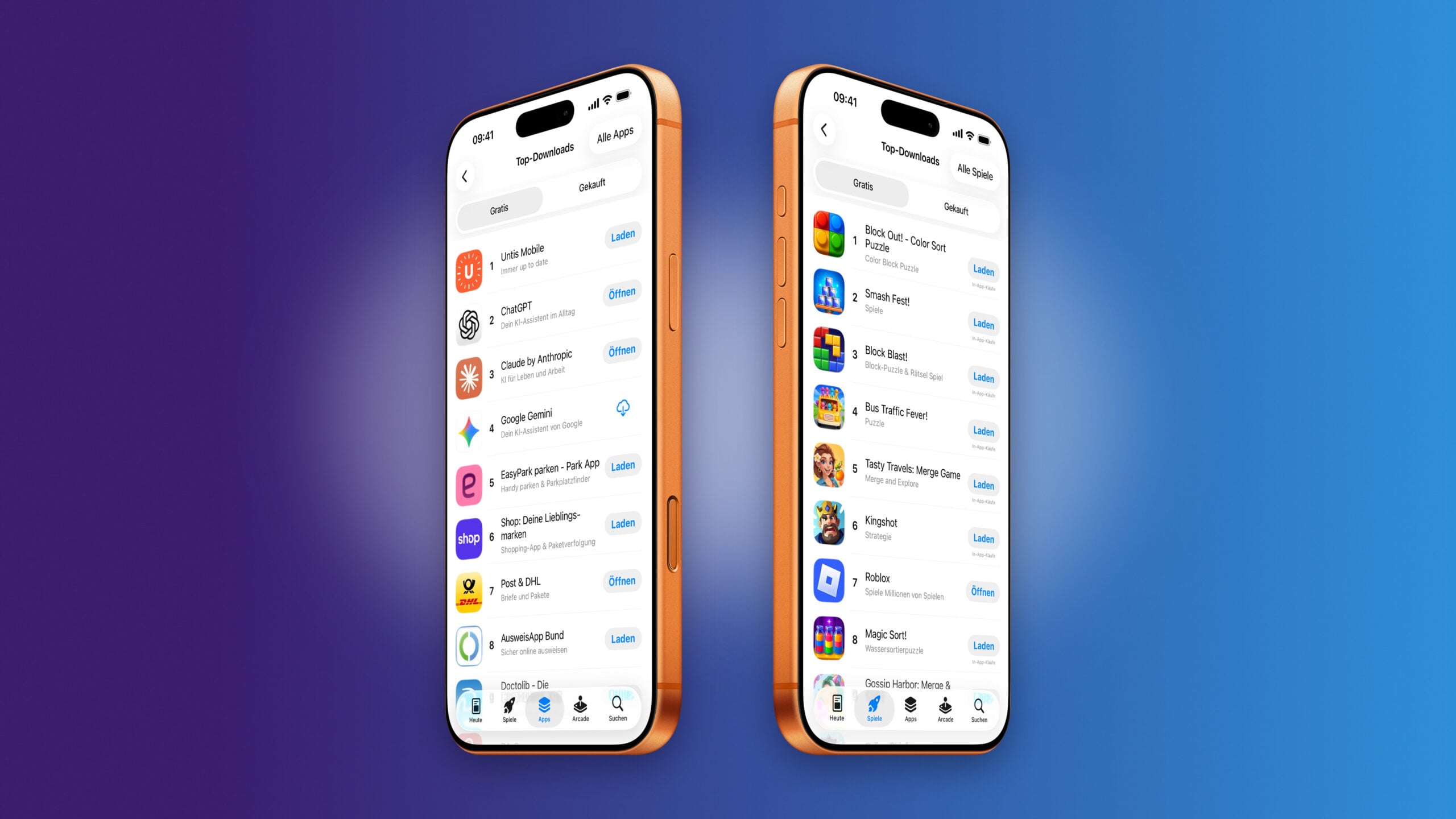
Global revenue from non-game apps grew by 14.6 percent in the second quarter, while game revenue declined by 4.5 percent. These figures confirm a shift that Apple itself has already addressed.
When Apple presented its figures for the third fiscal quarter at the end of July, its Services division fell short of expectations. The company cited weaker mobile gaming and regulatory interventions in the App Store model as reasons – both factors reflected in the breakdown explaining why Apple's Services missed expectations. Market research firm Sensor Tower has now published figures for the calendar quarter that provide significant evidence to support this claim.
Key Facts at a Glance
- Non-game apps generated $24.4 billion in revenue worldwide, an increase of 14.6 percent compared to the same quarter last year.
- Games generated $19.2 billion in revenue and lost 4.5 percent.
- Generative AI was the fastest growing category, doubling spending with an increase of 108 percent.
- The United States remains the largest market, but lost three percent in-app revenue.
- The figures include iOS and Android combined and are not solely App Store values.
The figures at a glance
What's striking about the report is the ratio of revenue to downloads. Games are downloaded significantly less often, yet generate almost as much revenue as all other categories combined – an indication of how much more intensively games monetize individual users.
| Segment | Revenue Q2 2026 | Change | Downloads |
|---|---|---|---|
| Apps without games | $24.4 billion | +14.6 percent | 25.5 billion. |
| Games | $19.2 billion | -4.5 percent | 11.3 billion. |
Both segments reach their users through the same channel: games and AI apps both appear in the free charts and cost nothing to download. Revenue is generated later – in games through in-game purchases, and in AI providers through subscriptions. The difference lies not in the distribution model, but in how many users actually pay later and how long they remain subscribed.
In terms of markets, the United States leads in in-app revenue with $14.8 billion, but this figure is down three percent. China follows with $5.98 billion, representing a ten percent growth. In terms of downloads, India leads with 6.67 billion installations, followed by the United States with 3.08 billion and Brazil with 2.43 billion.
Nine out of ten categories are up
Of the ten highest-grossing categories outside of games, nine saw growth. Generative AI led the field with 108 percent growth, while ChatGPT held around 60 percent of category revenue with an increase of 82 percent.
What's remarkable is the movement behind it: Claude climbed from seventh to second place in the category within a year and was also the biggest climber in in-app revenue overall, jumping 34 places to tenth. The provider had already reached the top of the app store charts at the beginning of March – the quarterly figures show that this was no flash in the pan.
The only shrinking category was dating, with a global decline of 11 percent, driven by a 34 percent drop in the US market. In Latin America, the trend was the opposite, led by Mexico with a 41 percent increase.
What the numbers don't tell
This survey has two limitations. First, the figures come from a market research company and not from the platform operators; Sensor Tower estimates based on its own models, which can systematically deviate from the actual billing figures.
Secondly, all the figures mentioned combine iOS and Android. Therefore, a decline in gaming does not automatically mean a decline of the same magnitude on Apple – the distribution between the platforms is not clear from the published excerpts.
The Sensor Tower report does not provide specific figures for Europe in the quoted passages. Therefore, no conclusions can be drawn about the German-speaking market from this.
Why this complicates Apple's calculations
For Apple, the postponement is more inconvenient than the overall market initially suggests. Games are the business where the company structurally earns the most: they are almost entirely generated through in-app purchases, meaning they go through Apple's own billing system and thus receive the full commission.
AI subscriptions work differently. Many providers also sell their access via their own websites, and in the EU, since changes to the App Store model, they are allowed to link to these websites from within the app. These very links are currently the subject of a legal proceeding in the United States, in which Apple is being forced to disclose its fee structure.
We expect this effect to intensify in the coming quarters. If the market grows primarily where Apple doesn't necessarily process payments, and shrinks where the company takes its full commission, then app revenue will continue to rise while Apple's share of it grows more slowly – the slowdown in services would then not be an anomaly of a single quarter, but rather the beginning of a trend.
Where the app market is headed
The market continues to grow, but its composition is shifting. Subscriptions for tools are in demand, no longer primarily in-game purchases. The next reliable indicator will come from Apple itself with its fourth-quarter results, which will reveal whether the services slump is prolonged. (Image: Apfelpatient)
- App Store: Apple must immediately present its fee model
- watchOS 27: Nine new colors for the modular watch face
- Last Seen: Apple TV shows trailer for the German-directed thriller