Apple is working on new ways to display information directly through materials that have previously been purely functional. A recent patent shows that fabric itself could become a display in the future. The focus is primarily on the HomePod, but the described technologies can also be applied to other Apple products. The approach is unusual, but consistent with Apple's previous development strategy.
Apple rarely takes the most obvious route with new product ideas. While a HomePod with a traditional screen would be technically the logical choice, patents suggest that Apple prefers to integrate displays invisibly into the design. Fabric plays a key role in this. The idea isn't new, but it has been systematically developed for several years. The current patent is just the latest in a long line of similar applications.
Apple and the idea of luminous fabric
The latest patent is titled "Fabric-Covered Electronic Device with Light-Emitting Components." In it, Apple describes how a fabric covering can display information itself. The fabric not only serves as a casing but actively becomes part of the user interface.
The article explains in detail how light can be guided through textile materials. A key problem is that fabric typically blocks light. Apple therefore proposes several solutions. Among other things, reflective coatings are applied to plastic fibers to direct the light outwards.
Additionally, optical fibers are embedded within the fabric strands. These fibers can conduct light and simultaneously emit some of it to the outside. This creates a luminous surface that can display patterns or symbols.
The HomePod as a key example
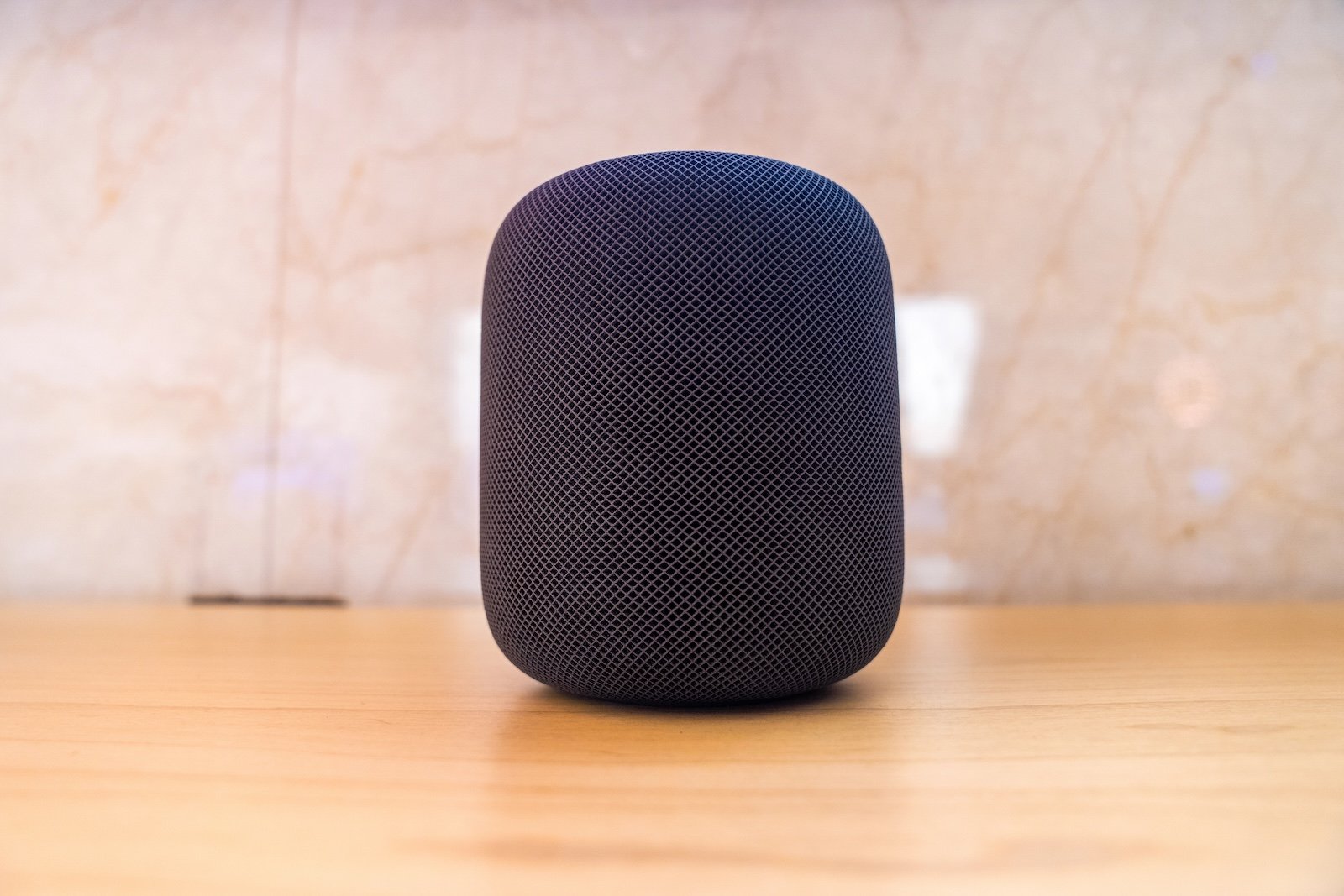
The patent specifically describes a voice-controlled loudspeaker device with a cylindrical shape. This makes it clear that the HomePod serves as the reference device. The housing is said to contain a speaker that emits sound and an integrated display located beneath the fabric.
Apple describes the construction of this display in great detail. It consists of a substrate with light-emitting components, an opaque support structure, a diffuser, a display cover, and foam elements between the individual layers. The goal is a uniform light distribution without individual light points being visible.
The arrangement of the light sources is particularly important. They are organized into groups that are identical in structure, but whose orientation changes depending on the viewing angle relative to the center of the display. This allows information to be displayed in a targeted manner, depending on the viewing angle of the HomePod.
Not a classic screen, but an information display
Apple's patent does not envision creating a fully functional screen from fabric. Instead, the focus appears to be on simple, clear information. Symbols, light patterns, or visual cues are paramount, not videos or complex graphics.
This also makes it clear that this is not about decorative blinking. The arrangement of the light-emitting components is so precisely planned that specific content can be displayed. This clearly distinguishes this approach from simple status lights.
Previous patents demonstrate a long-term strategy
The current patent is not an isolated case. Back in March 2020, Apple filed a patent for a fabric-covered electronic device with a touch sensor. At that time, the focus was on touch input via the fabric. Further applications followed in 2021, some focusing on touch functionality and others on illuminated fabrics.
Some of these patents described how fabric areas could be used as touch-sensitive buttons. It was also mentioned at the time that the fabric around these areas could glow. In March 2021, Apple shifted the focus significantly to the lighting function and brought the idea of a fabric-based display more to the forefront.
Possible use cases
Although Apple provides few concrete use cases in its patents, some applications are easy to infer. In a room with multiple HomePods, the device currently responding to a voice command could visually indicate that it is listening. A gesture to mute the device could trigger an icon such as a speaker with a line through it or a pause button to appear on the fabric surface.
Such displays would be discreet but easily understandable. They would provide feedback without requiring additional screens or displays.
Not just for the HomePod
As is typical for Apple, the patent concludes with a wide range of potential devices. Besides speakers, iPhone cases, Apple Watch bands, and other fabric-covered products are also possibilities. The technology is deliberately kept open to allow its application to different product categories.
What patents mean and what they don't
Despite the many details, it's important to remember that a patent is no guarantee of a finished product. Apple regularly files patent applications for ideas that never make it to market. It's entirely possible that this technology will continue to be developed internally without ever being visibly deployed.
However, the frequency of similar patents over several years is striking. This suggests that Apple is seriously pursuing this issue and not just considering it experimentally.
Apple's long-term vision for invisible displays
Apple is clearly investing significant time and energy in the development of fabric displays and light-emitting textiles. The HomePod serves as a prime example, but it's not the only conceivable application. Whether and when such a product will appear remains to be seen. What is clear, however, is that Apple is working towards a future where displays are no longer clearly recognizable as such, but rather seamlessly integrated into the design of the devices. The best products for you: Our Amazon storefront offers a wide selection of accessories, including those for HomeKit. (Image: Wirestock / DepositPhotos.com)
- Apple wins long-running dispute over iPhone camera patents
- Apple develops magnetic game controller for iPhone & iPad
- Apple relies on smart mattress sensors for sleep tracking
- Apple develops next-generation Taptic Engine
- Apple Ring – new patents give hope for an innovative wearable
- Apple Vision Pro could get more touch controls
- Apple files patent for iPhone made from a single piece of glass
- Apple is working on light signals for Apple Ring and more
- Apple files patent for new mouse button in keyboard
- Will Apple Pencil soon be available as a stylus for all Apple devices?
- Apple patent proves: AirPods with cameras in development
- Apple could improve Vision Pro for travel via software
- AirPods learn to read lips: Apple plans silent control
- Apple patent shows: iPhone could soon control everything automatically
- New research: Apple develops hinges for foldable iPhone
- Magic Mouse: Apple is working on touchless control
- Apple Patent: More action buttons for iPhones and more
- iPhone: Face ID under the display is within reach