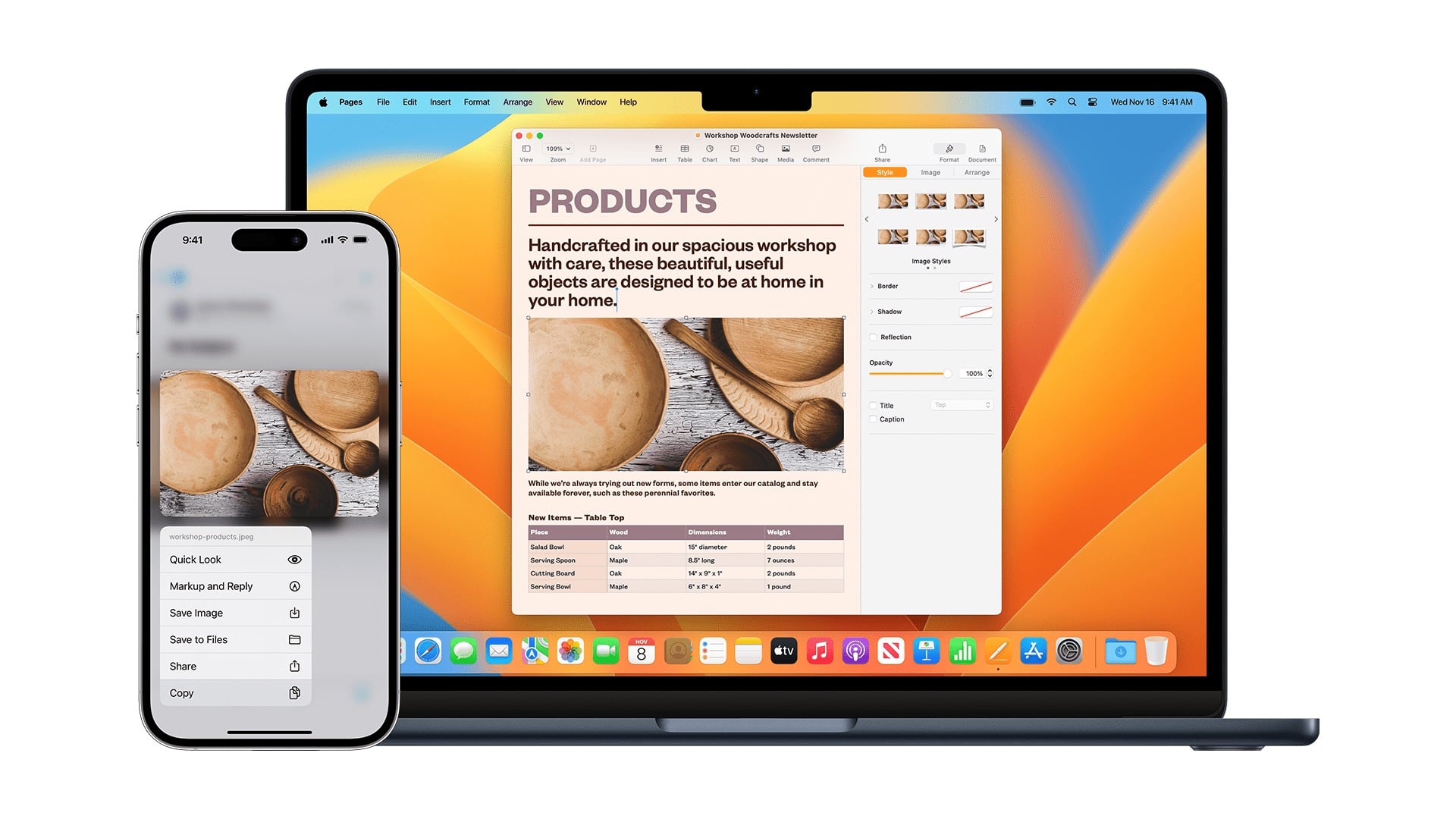
Copying text on your iPhone and pasting it directly into your Windows PC – Apple is working on precisely this feature. Microsoft initiated the process through the application procedure that Apple established due to the Digital Markets Act. However, the timeline extends well into 2027.
For years, copying files between two Apple devices has worked seamlessly: copy on one, paste on the other. However, there's currently no built-in way to do this between iPhones and Windows PCs. That's about to change – and the impetus isn't coming from Cupertino, but from Redmond. Microsoft requested the functionality through Apple's interoperability application process, which was established for EU developers. The fact that a European regulation is bringing about this feature reverses the usual pattern: the EU is typically on the list of features that are missing.
Key Facts at a Glance
- Apple is developing a cross-device clipboard between iOS devices and Windows PCs.
- Microsoft applied for the feature under the Digital Markets Act, Apple has been reviewing it since March and submitted a project plan on June 26.
- The Windows PC is technically treated like a coupled accessory device, requiring a one-time activation by the user.
- Completion is scheduled for autumn 2027, but the feature may not be publicly available until early 2028.
- It is expected that it will remain limited to the EU – Germany and Austria would participate, but Switzerland would not.
What Microsoft demanded
Microsoft outlines three points in its application. Users should be able to copy text and other supported content on their iPhone and paste it directly on their Windows PC, and vice versa.
This should work without repeated manual steps, meaning without having to bring an app to the foreground each time. And the synchronization should operate as a continuous function, not as a single transfer initiated by an app.
The reason for the request lies in a restriction that applies to all apps: An app may only read the iPhone's clipboard if it is actively running in the foreground and the user grants access for each individual action. Apple introduced this prompt after it became known how many apps were reading data unnoticed – macOS later received a corresponding privacy update for the clipboard. This method is therefore blocked for continuous background synchronization.
How Apple's solution is supposed to work
Apple proposes that an iPhone can share clipboard content with and receive content from a paired accessory. In this scenario, a Windows PC falls under the category of "accessory."
The model is a mechanism that Apple has already implemented: With iOS 26.5, AirPods functions were opened up to wearables from other manufacturers in the EU, including the forwarding of notifications. The same logic is intended to apply to the clipboard.
Microsoft would need to integrate the AccessorySetupKit for this to work. The user then grants permission once per paired device to share the clipboard – after that, it works without further prompts.
The detour via the accessory interface has a technical reason. Apple's own universal clipboard requires that both devices are logged in with the same Apple account, have Wi-Fi, Bluetooth, and Handoff enabled, and are no more than ten meters apart. A Windows PC cannot, in principle, meet the first condition.
Germany and Austria yes, Switzerland no
This is the crucial point for readers in German-speaking countries. The obligation stems from the Digital Markets Act, which applies throughout the European Union. Germany and Austria are therefore covered.
Switzerland is neither in the EU nor the EEA and therefore falls outside the scope of the DMA. For most DMA-related issues, this is an advantage because Swiss devices are spared restrictions – but the opposite is true for a feature that only arises through regulation. Swiss users would only get the shared clipboard if Apple voluntarily rolls it out worldwide.
This is not a theoretical case. Apple has implemented several DMA requirements beyond the EU, while deliberately limiting others to specific regions.
| Feature | Trigger | Availability |
|---|---|---|
| eSIM transfer from iPhone to Android | DMA | worldwide |
| Simplified data transfer between Android and iPhone | DMA | worldwide |
| AirPods-like pairing for third-party accessories | DMA | EU only |
| Notifications to third-party wearables | DMA | EU only |
| Shared clipboard with Windows | DMA | planned, likely only EU |
The fact that Apple and Google have simplified device switching worldwide shows that global release is possible. It depends on whether Apple views the feature as a useful addition or merely as a legal obligation.
The timetable extends to 2028
Apple describes the implementation as a significant technical undertaking and expects completion in the fall of 2027. Only then will the feature enter a developer beta before being released publicly.
If completion falls at the end of this timeframe, the general public will likely not be able to use the feature until early 2028 at the earliest. This would leave approximately three years between Microsoft's application and its practical application.
A Windows PC as an accessory device
What's remarkable about Apple's proposal is less the function itself than the chosen approach. Instead of building its own interface for third-party operating systems, Apple places the Windows PC in an existing category: paired accessories, like headphones or a smartwatch.
This is both elegant and restrictive. Elegant because no new authorization model is needed, and the one-time approval remains transparent for users. Restrictive because an accessory device never achieves the status of an equal partner in Apple's system architecture – the connection remains asymmetrical, and the iPhone retains control.
In practical terms, this means little in the short term. If you currently exchange content between your iPhone and Windows PC, you'll still have to resort to workarounds like email, messaging apps, or cloud services. The feature being discussed here will arrive in an iOS generation that hasn't even been announced yet.
One caveat: A submitted project plan is not a guarantee of a delivery date. Apple has repeatedly criticized how competitors use the application process and is taking legal action against parts of the regulation. Delays would not be surprising in this environment.
How closely iPhone and Windows are getting together
The shared clipboard would represent the deepest integration to date between iOS and a third-party desktop operating system. It arises not from a partnership, but from an obligation – ironically, between two companies that are currently facing each other in court. The true consequences of the DMA for Apple in Europe are more clearly illustrated by this case than by most fine announcements. (Image: Apple)
- Laura Legros returns to Apple out of retirement
- iCloud: Former Apple employees retained access
- Apple Store: Accessories section completely redesigned